
United States
The mileage log the IRS describes, kept by your phone.
Miles by default when you pick the United States. The IRS standard rate applied to each trip at the rate of its date, across the July 2026 change. Total miles for the year from your odometer readings. One PDF for Schedule C or for the employer that reimburses you.
- Each trip records date, endpoints, business purpose and miles, the four things Publication 463 lists, at the time of the trip.
- Saved places tag a trip as Business or Personal and name a client, so the log reads like a log, not a GPS dump.
- Parking and tolls on business trips are added on top of the standard rate, the way the IRS allows.
- Medical and charity driving get their own purpose and their own rate; commuting stays personal.
Rates
IRS standard mileage rates
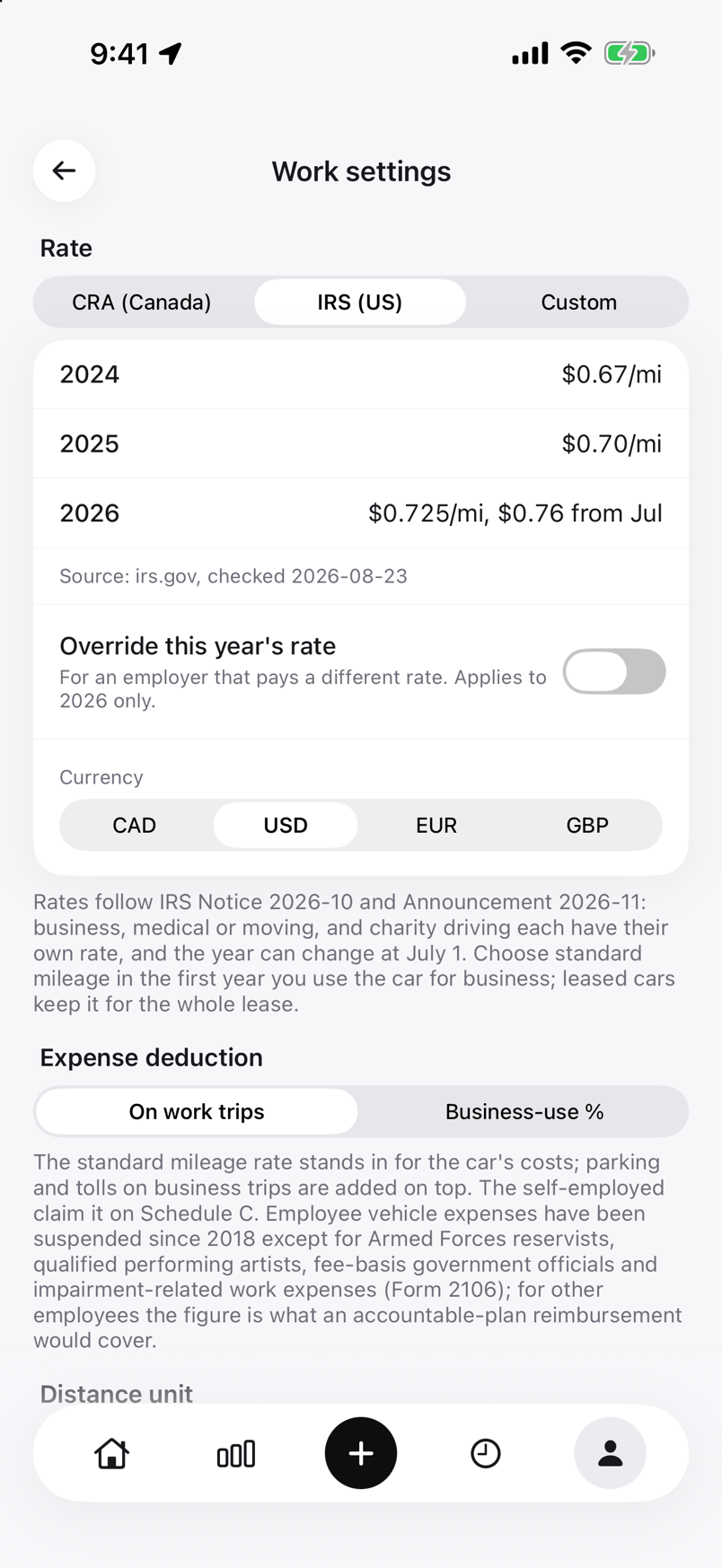
The cents per mile the IRS allows for business use of a car, and the lower rates for medical or moving and for charity. Odie applies the business rate in force on each trip’s date, so a 2026 report lists the January to June miles at 72.5¢ and the July to December miles at 76¢. The figure it shows is the deduction under the standard mileage method for the self-employed, or a reimbursement estimate for an employee. The app carries the IRS table for 2024 to 2026 from irs.gov and has an override for an employer that reimburses at a different figure this year.
| Period | Business | Medical or moving | Charity |
|---|---|---|---|
| Jul 1 to Dec 31, 2026 | 76¢ | 23.5¢ | 14¢ |
| Jan 1 to Jun 30, 2026 | 72.5¢ | 20.5¢ | 14¢ |
| 2025 | 70¢ | 21¢ | 14¢ |
Sources: Standard mileage rates, irs.gov. The figures for each period come from the IRS notice or announcement linked in the Period column.
Records the IRS expects
Publication 463 asks for adequate records: for each business use of the car, the date, the destination, the business purpose and the miles, plus the total miles you drove the car in the year. It wants them written at or near the time of the trip; a log reconstructed at year end from a calendar is what an examiner questions. Schedule C, Part IV, asks the same thing in four boxes (total, business, commuting and other miles) and whether you have written evidence. Odie fills the trip rows as you drive and takes the year’s total from the odometer readings you enter, so the four boxes come straight off the report.
Keep the log for as long as the return can be examined, generally three years from the date you filed, and keep car records until the period of limitations expires for the year you dispose of the car. The IRS’s record-keeping page has the longer periods.
Employees, Form 2106 and accountable plans
Most W-2 employees cannot deduct mileage. Section 70110 of the 2025 budget law made the suspension of miscellaneous itemized deductions permanent, and unreimbursed employee travel is one of them; Notice 2026-10 says so in its section 3. Four groups still deduct, on Form 2106: Armed Forces reservists, qualified performing artists, fee-basis state or local government officials, and employees with impairment-related work expenses.
For everyone else the route is reimbursement by the employer under an accountable plan. Publication 463 gives it three requirements: the expenses have a business connection, you account to your employer for them within a reasonable period, and you return any excess within a reasonable period. A reimbursement at or below the standard rate under such a plan is not income to you. Odie’s report, with the date, purpose and miles of each trip, is the accounting; the accountable plan section of Publication 463 has the rest.
States that require reimbursement
Federal law decides what you may deduct. Three states go further and oblige the employer to pay you back for work driving, whatever the federal deduction says. As read on August 23, 2026:
| California Labor Code s. 2802 | The employer must indemnify the employee for all necessary expenditures incurred in direct consequence of the discharge of their duties. |
| Illinois 820 ILCS 115/9.5 | The employer must reimburse necessary expenditures within the scope of employment; the employee submits them with documentation within 30 calendar days unless the written policy allows longer. |
| Massachusetts 454 CMR 27.04(4)(b) and (d) | An employee sent to a location other than the regular work site is reimbursed for the associated transportation expenses, and one required to travel from one place to another during the work day is paid for the travel time and reimbursed for all transportation expenses. |
None of the three names a rate; the IRS standard rate is the figure most employers use because it is the one the IRS treats as reasonable. If you are in one of these states, the log is what you hand your employer with the claim.
Odie is an independent app. It is not affiliated with the Internal Revenue Service or any state agency, and nothing on this site is tax advice. Your tax preparer knows your situation; this is the log you bring them. Sources: Publication 463, Schedule C instructions, Topic 510, checked August 23, 2026.
Standard mileage or actual expenses
Under the standard mileage method, business miles times the IRS rate, plus parking and tolls, is the deduction, which is why a clean log matters. Under the actual expense method you add up what the car cost you (gas, insurance, repairs, depreciation) and claim the business share, the percentage of your miles that were for work. You cannot use the standard rate with five or more cars in use at once. Odie gives you the log either way, records expenses with receipts, and can work out the business-use percentage. Your tax preparer decides which method to use.
What the report contains
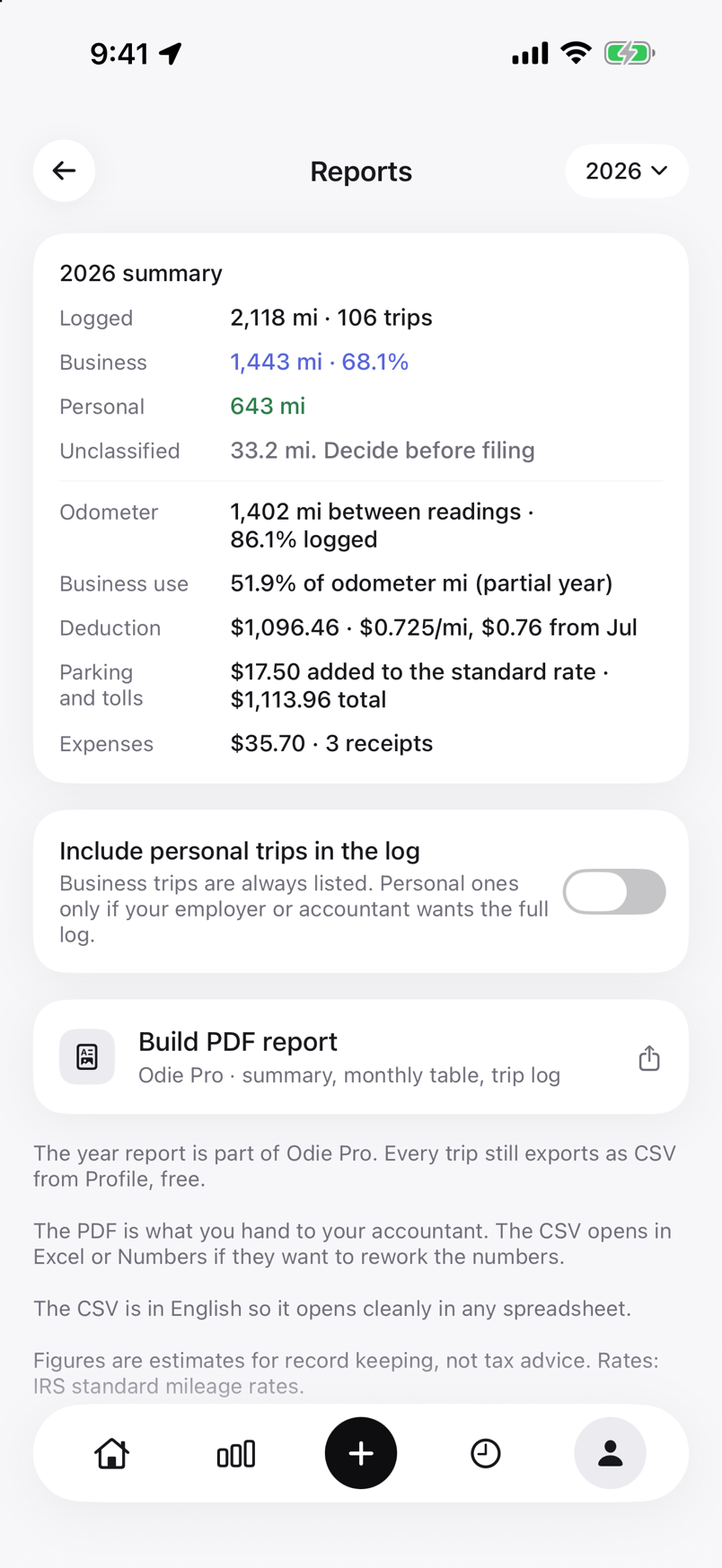
- A summary of business and personal miles and the deduction at the rate in force on each trip’s date, with the formula
- Parking and tolls on business trips, on their own line
- A monthly table and a per-client or per-project table
- Expenses by category, with receipts kept in the app
- The full trip log: date, from, to, client, purpose, miles
- Odometer readings at the start and end of the year, for the total-miles box
Delivered as a PDF and a CSV. A separate export gives every trip as CSV.
United States questions
Is the report “IRS compliant”?
The IRS does not certify apps, so no app can honestly say it is certified. What the IRS publishes is what a record must show: the date, the destination, the business purpose and the miles of each business trip, written down at or near the time, plus the total miles for the year. Odie’s year PDF contains each of those, which is what your tax preparer will check. The IRS’s own pages are Publication 463 and Topic 510.
Self-employed or employee: which method?
If you file Schedule C, business miles times the standard rate, plus parking and tolls, is your deduction under the standard mileage method, and Odie’s default per-trip method gives you that figure. The actual expense method claims the business share of what the car cost instead; switch Odie to the business-use method in Work settings and it applies your percentage to your logged expenses. For a car you own, the choice is made in the first year it is used for business, and a leased car keeps the standard rate for the whole lease. If you are a W-2 employee, the figure Odie shows is what a reimbursement at the IRS rate would be, not a deduction; see the employees section on this page. Either way, keep the log for as long as the return can be examined, generally three years, and remember that commuting between home and a regular workplace is personal.
What about state rules?
Federal rules decide the deduction. Some states add an obligation on the employer to reimburse work driving, whatever the federal deduction says: California, Illinois and Massachusetts are the ones with a statute or regulation that names transportation expenses. The section above quotes each one. Odie’s report is the record you hand your employer under any of them.
Does Odie know about the 2026 split rate?
Yes. The IRS table in the app holds 2024 at 67¢, 2025 at 70¢, Jan to Jun 2026 at 72.5¢, Jul to Dec 2026 at 76¢, from irs.gov, checked August 23, 2026. Each trip is priced at the rate of its date, and the report’s Deduction line shows the miles at each rate.
Tools
By job
IRS guides
- Real estate agent mileage deduction (IRS)Showings, open houses and brokerage drop-offs are business miles for a self-employed agent. Schedule C wants them counted separately, not estimated.
- Uber and DoorDash mileage deduction (IRS)Why an Uber or DoorDash trip summary misses miles the IRS still counts, the $400 line that requires a return, and the 1099-K threshold that does not change it.
- Accountable plan rules for mileage reimbursementHow employers keep mileage reimbursements tax-free and off your W-2: the IRS’s three accountable plan rules, the 30, 60 and 120-day deadlines, and missed ones.
- Can W-2 employees deduct mileage? (IRS)IRS Topic 510 names three W-2 job categories that still deduct car expenses on Form 2106, and what that means for everyone else driving for work.
- IRS adequate records for car expensesPublication 463's own worksheet for a mileage log, why filling it in once a week still counts as timely, and how one logged week can stand for a month.
- IRS standard mileage vs actual expensesThe IRS lets you choose once, in a car's first business year. How the same trips price out both ways, what locks in, and why depreciation can make it close.
- IRS standard mileage rate 2026: 72.5¢ and 76¢72.5 cents for January through June, 76 cents from July 1, how that compares with 2025, and what it means for a log that crosses the midpoint.
Start your IRS mileage log.
Odie records each business mile as you drive and prices it at the IRS rate of its date. Free for 40 automatic trips a month.