
Mileage log · Professional services
Mileage tracker for consultants and freelancers
A consultant’s driving is uneven: a week at a client’s office, then nothing, then three meetings in a day. Because it comes in bursts, it is easy to forget. Odie logs each drive and lets you put the client on it.

No account. Free for 40 automatic trips a month, no card.
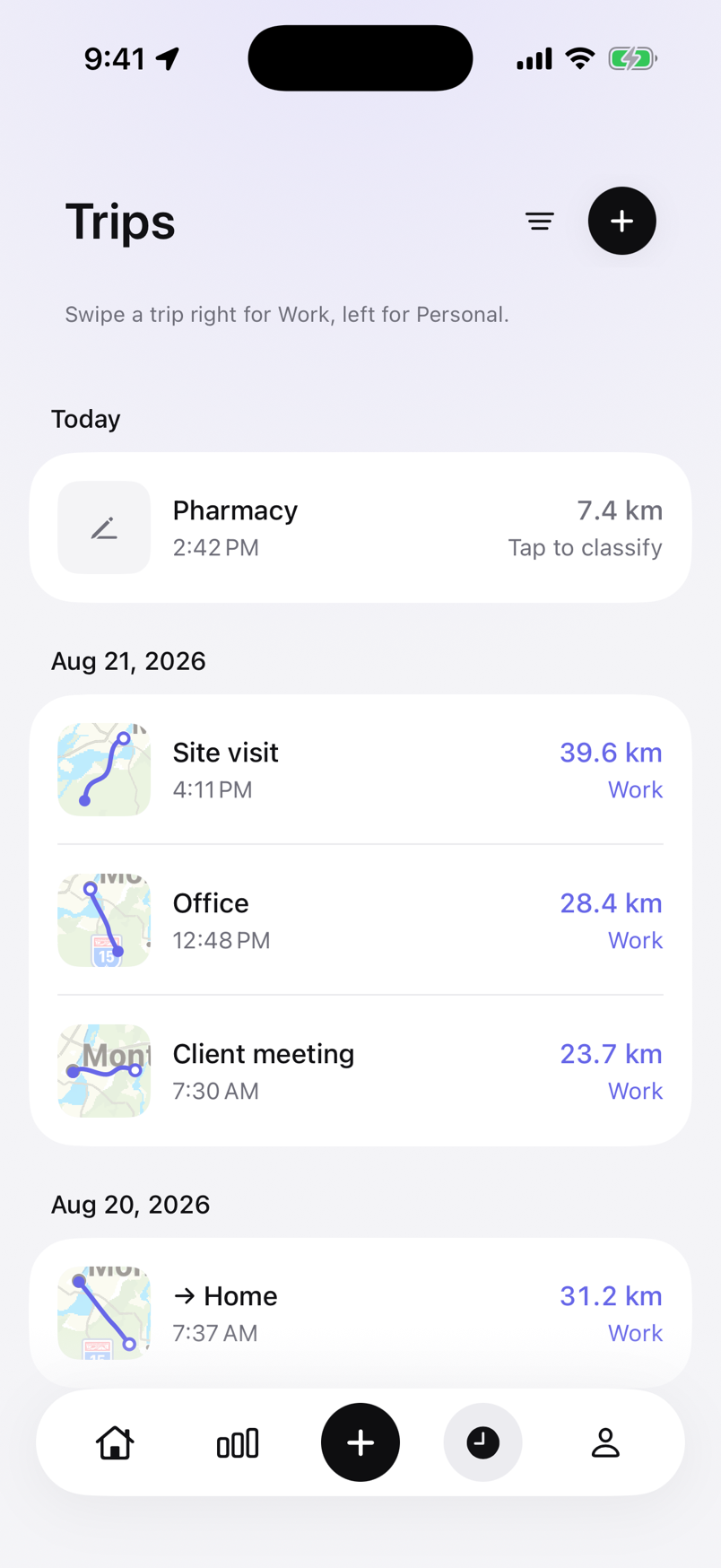
A day on the road
A day with two clients:
- WorkHome office to a workshop at a client’s offices
- WorkWorkshop to lunch with a prospective client
- WorkLunch to a coworking space you rent by the day
- PersonalCoworking space to pick up the kids
The business share for a consultant is often under half, which makes every logged business kilometre count for more of the deduction.
What counts as business driving
In the log as Work
- Meetings and workshops at client offices
- Prospect meetings and networking events for the business
- Drives to a coworking space that is not your regular workplace
- Trips to a courier, bank or office supplier for the business
Not business
- Home to an office you rent and work from every day
- School runs and errands in the same car
- Social events that are not for the business
What the log is worth
A worked example for a self-employed driver in each country. Your numbers will differ; the method is the same.
Canada · self-employed
9,000 business km out of 20,000 km in total is 45.0% business use. Applied to $9,000 of car costs for the year, that is
$4,050
Deducted on the T2125. There is no per-kilometre deduction for the self-employed: it is a share of real costs, and the log proves the share.
The CRA on motor vehicle expensesUnited States · self-employed
6,000 business miles at the IRS standard rate of 76¢ (Jul 1 to Dec 31, 2026) is
$4,560
Deducted on Schedule C if you use the standard mileage rate. Business parking and tolls go on top.
Schedule C instructionsYour vehicle
Most consultants use one car for everything. The deduction is the business share of real costs in Canada, or the standard rate or actual expenses on Schedule C in the United States. If you bill clients for mileage, the per-client totals in the log are the support.
Expenses to keep with the log
- Parking at client offices
- Tolls
- Fuel or charging
- Insurance and maintenance, as the business share
What Odie does
- Starts a trip when your vehicle’s Bluetooth connects and you are moving, and ends it when you park.
- Asks Work or Personal from the lock screen, and suggests the answer after the same route twice.
- Keeps fuel, charging, parking and toll receipts next to the trips.
- Builds the year report: summary, monthly and per-client totals, expenses, the trip log and the odometer readings.
Tag each work trip with the client, and the year report gives per-client kilometres and amounts. That table doubles as backup for mileage you bill. See a sample year report (PDF)
Questions
I work from home. Is every drive to a client business?
When home is your main place of business, the drive out to a client is business in both countries. A drive to an office you rent and use every day is the commute.
I bill clients for mileage. Is that the same as the deduction?
No. What you bill is income; what you deduct is the business share of your car costs (Canada) or the standard rate or actual expenses (US). The same log supports both.
Should I use the standard mileage rate in the US?
It depends on your car and your miles, and the choice is made in the first year the car is used for business. See standard rate or actual expenses.
Informational, not tax advice. Your accountant knows your situation.
Guides
-
Is driving to work deductible in Canada? The CRA rule
Home to your regular workplace is personal. What the CRA counts as business driving instead, a worked example, and how to log trips so the split holds up.
-
CRA mileage allowance vs self-employed deduction
A T2200 employee and a T2125 sole proprietor account for the same driving in different ways. The two systems side by side, with one worked example.
-
IRS standard mileage vs actual expenses
The IRS lets you choose once, in a car's first business year. How the same trips price out both ways, what locks in, and why depreciation can make it close.
-
Claiming EV charging as a vehicle expense (CRA)
How electricity fits into a business vehicle claim in Canada: what to record per charge, how to handle home charging, public receipts, and the charger itself.
Your next work trip can log itself.
Odie is on the App Store, free to start.