
Canada
The vehicle logbook the CRA describes, kept by your phone.
Kilometres by default. The CRA’s two allowance tiers applied in date order. Start and end odometer readings in the report. The whole thing in French or English, built in Montréal.
- Each trip records date, endpoints, purpose and distance, the four things the CRA lists.
- Saved places tag a trip as Work or Personal and name a client, so the log reads like a logbook, not a GPS dump.
- Odometer readings give the year’s opening and closing figures and tell you what share of your driving was logged.
- Self-employed? The business-use method applies your percentage to gas, charging, parking, tolls and maintenance.
Rates
CRA automobile allowance rates
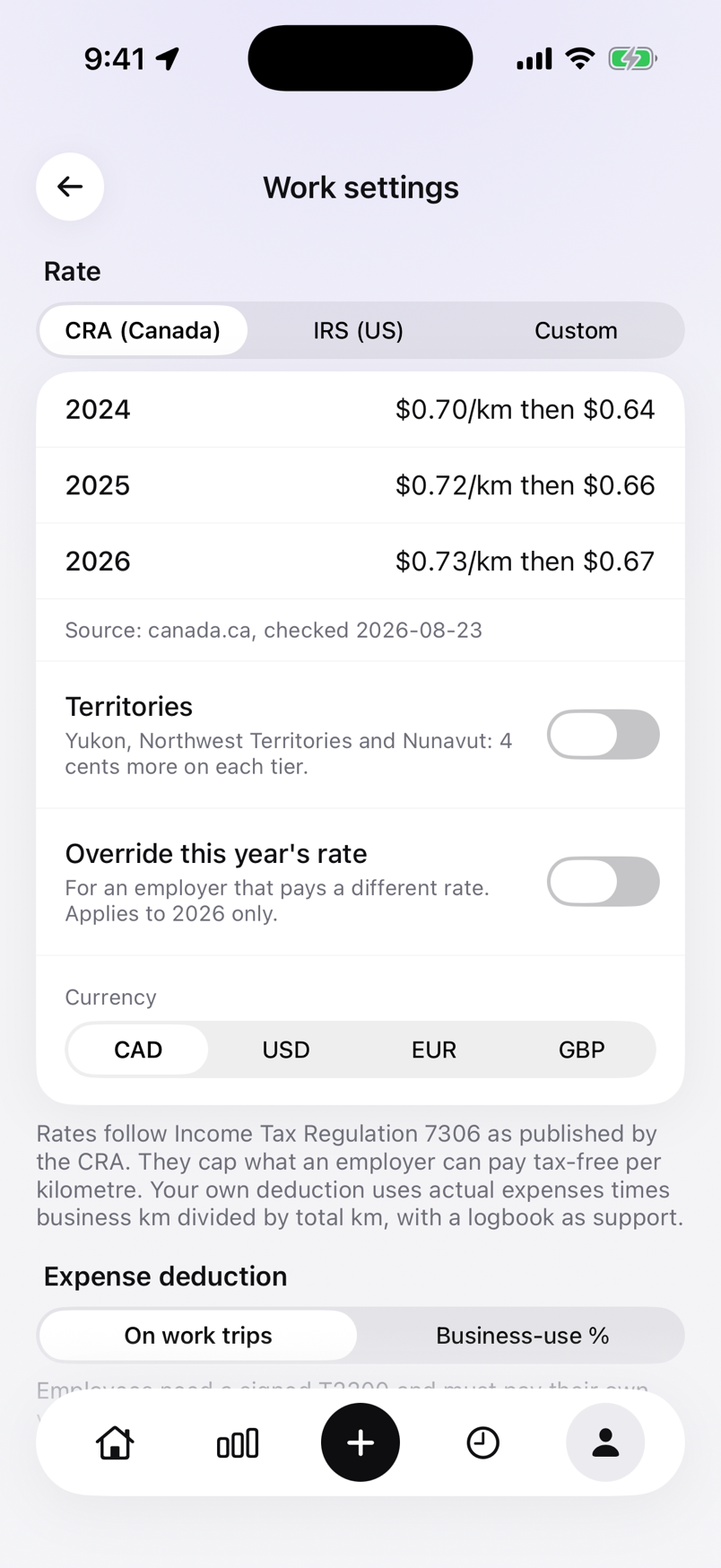
The per-kilometre amounts an employer can pay tax-free. Odie applies the first tier to your first 5,000 business kilometres in the calendar year, across all your cars, and the second tier after that. The figure it shows is an employer allowance estimate, not a deduction. The app carries the CRA table for 2024 to 2026 from canada.ca, prices each trip at the rate of its date, and has a switch for the territories and an override for an employer that pays a different rate this year.
| Year | First 5,000 km | After 5,000 km | Yukon, NWT, Nunavut |
|---|---|---|---|
| 2026 | 73¢ | 67¢ | +4¢ |
| 2025 | 72¢ | 66¢ | +4¢ |
| 2024 | 70¢ | 64¢ | +4¢ |
Sources: Automobile and motor vehicle allowances, canada.ca, checked October 9, 2026. The figures for each year come from the Finance Canada release linked in the Year column.
Full logbook, then a three-month sample
The CRA asks for a full logbook for one base year. After that you may keep a logbook for one three-month period each year and scale it against the base year, provided the business use you measure stays within ten percentage points of the base year. Since Odie runs by itself, most people simply keep the full log every year and skip the arithmetic, but the sample method is there if you want it: the report can be run for any year, and the CSV makes the three-month subset easy to pull.
Registre des déplacements in Québec
Revenu Québec uses the same fields and adds a hand-over rule that applies only when the employer makes the automobile available to the employee: a copy of the registre goes to the employer by the tenth day after the year ends, and the Taxation Act sets a $200 penalty for missing it. If you drive your own car, the rule does not apply to you. Odie’s PDF is the document to hand over. The French version of this page, and the rest of the French site, use Revenu Québec’s terms.
Odie is an independent app. It is not affiliated with the Canada Revenue Agency or Revenu Québec, and nothing on this site is tax advice. Your accountant knows your situation; this is the logbook you bring them.
Canada questions
Is the report “CRA compliant”?
The CRA does not certify apps, so no app can honestly say it is certified. What the CRA publishes is a list of what a logbook must contain: the date, destination, purpose and distance of each business trip, and the odometer reading at the start and end of the year. Odie’s year PDF contains each of those, which is what your accountant will check. The CRA’s own page is here.
Employee or self-employed: which method?
If an employer pays you a per-kilometre allowance, the CRA tier rates apply and Odie’s default per-trip method fits: kilometres times the rate is an estimate of the allowance, not a deduction. An employee who is paid a reasonable allowance normally cannot also deduct vehicle costs. An employee who pays their own costs and has a signed T2200 deducts actual expenses times the employment-use share, on line 22900; the CRA’s page is here. If you are self-employed, you deduct the business-use share of your actual vehicle costs on form T2125 (business km over total km); switch Odie to the business-use method in Work settings and it applies your percentage to your logged expenses. The CRA’s T2125 guidance is here. Either way, keep the log for six years from the end of the tax year, and remember that home to a regular workplace is personal.
What about Revenu Québec?
Québec follows the same logbook idea and adds a deadline that applies only to an automobile made available by the employer: the employee gives the employer a copy of the registre des déplacements by January 10 of the following year (Taxation Act s. 41.1.4), and the penalty for not doing so is $200 (s. 1049.34). It does not apply to an employee driving their own car. Revenu Québec’s page is here. The French pages on this site use Revenu Québec’s wording.
Is the whole app in French?
Yes. The interface, the notifications, the widget and the PDF report are in French when your iPhone is. A small number of strings are still being translated; the app shows English for those until they are.
Tools
- CRA mileage rate
- CRA mileage calculator
- Vehicle expense calculator
- Mileage log template
- CRA log checklist (PDF)
By job
CRA guides
- CRA mileage rate 2026 medicalThe CRA allowance is 73¢ then 67¢ everywhere in Canada for 2026. A separate per-province rate, only published for 2025, covers medical, moving and northern travel.
- Changing cars mid-year: mileage log (CRA)A June trade-in does not merge two trucks into one logbook. Close the old odometer, open the new one, and keep the two business-use percentages apart.
- Mileage log with two cars for one businessA cargo van at 86% business use and a sedan at 20% cannot share one logbook. Why the CRA wants each vehicle's kilometres and costs kept apart.
- Are parking and tolls deductible? (CRA)Why parking and supplementary insurance skip the CRA's business-use percentage, what tolls fall back on instead, and how the employee route differs.
- Capital cost allowance for a vehicle in CanadaHow a vehicle's purchase price turns into a yearly deduction on Form T2125, the $39,000 line that sets the class, and what changes for an electric one.
- Form T2200: what to ask your employer forWhat signing Form T2200 actually certifies, the two conditions that have to be true before your employer will sign it, and what a mileage log still has to show.
- Is driving to work deductible in Canada? The CRA ruleHome to your regular workplace is personal. What the CRA counts as business driving instead, a worked example, and how to log trips so the split holds up.
- Odometer readings for a CRA mileage logWhy the CRA asks for odometer readings at the start and end of the year, how two readings turn a log into a T2125 percentage, and a monthly check for gaps.
- Claiming EV charging as a vehicle expense (CRA)How electricity fits into a business vehicle claim in Canada: what to record per charge, how to handle home charging, public receipts, and the charger itself.
- CRA mileage allowance vs self-employed deductionA T2200 employee and a T2125 sole proprietor account for the same driving in different ways. The two systems side by side, with one worked example.
- Reconstructing a mileage log after missing monthsHonest guidance when the log has gaps: what evidence helps, what the CRA accepts and does not, and why prevention is cheaper than reconstruction.
- CRA mileage logbook requirementsThe full logbook, the simplified three-month sample, the 10-point rule with its formula, what each trip record needs, and how long to keep it.
- CRA automobile allowance rates 2026: 73¢ and 67¢The per-kilometre rates the CRA treats as reasonable for 2024, 2025 and 2026, what the two tiers mean, who they apply to, and a worked example for 6,200 km.
Start your CRA mileage log.
Odie records each trip with your car and keeps the odometer readings the CRA asks for. Free for 40 automatic trips a month.