
Mileage log · Real estate and property
Mileage tracker for real estate agents
Showings, listing appointments, open houses and inspections add up to most of an agent’s driving, and none of it happens on a schedule you would remember in April. Odie logs each leg as you drive, with the client on the trip.

No account. Free for 40 automatic trips a month, no card.
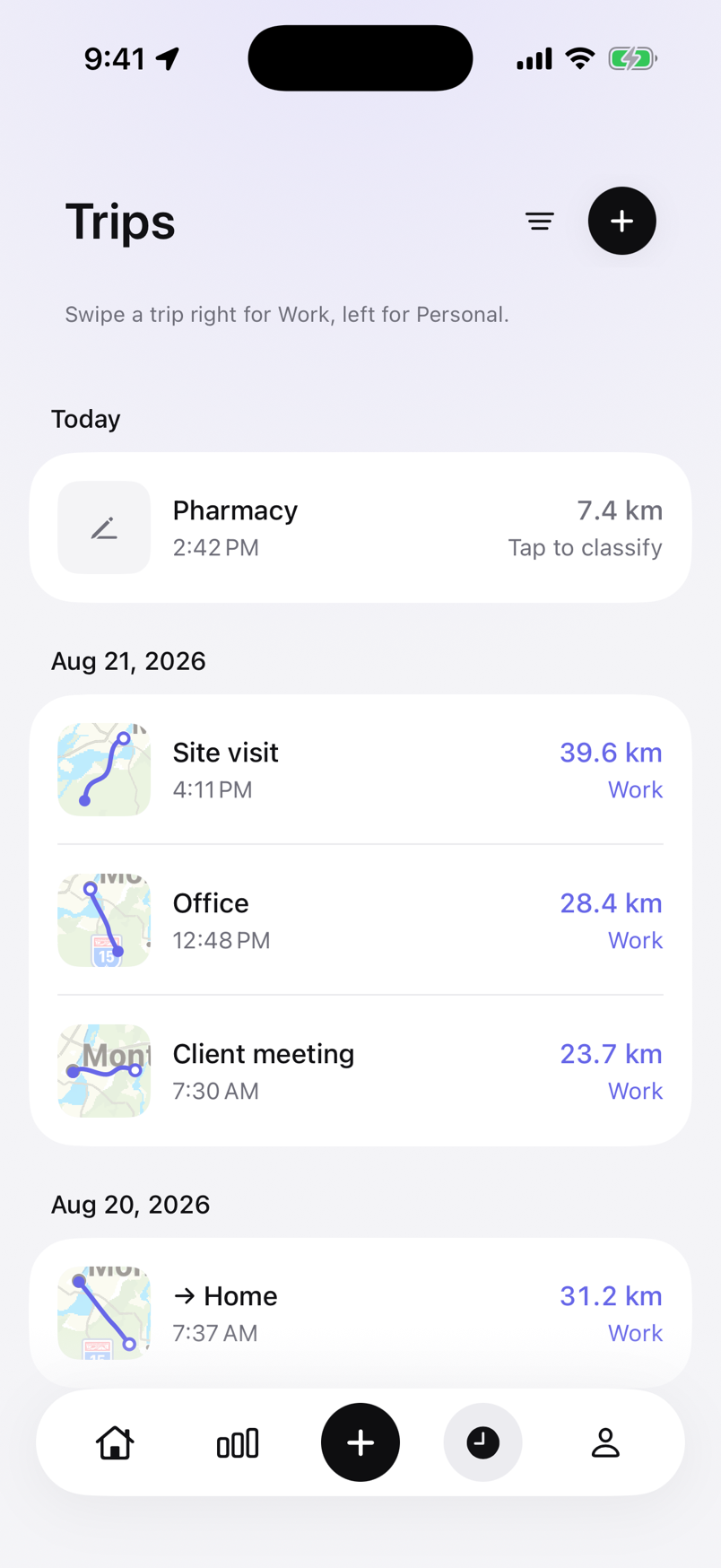
A day on the road
A Saturday with two buyers and an open house:
- WorkHome to a listing to set up the open house
- WorkListing to a showing across town with the first buyer
- WorkShowing to a second property with the same buyer
- WorkBack to the open house for the afternoon
- PersonalOpen house to the grocery store on the way home
Five drives, four of them business. The fifth is the one people forget to leave out.
What counts as business driving
In the log as Work
- Showings and second visits with buyers
- Listing presentations and photo or staging appointments
- Open houses, including setting up and closing
- Inspections, appraisals and walkthroughs you attend
- Dropping off documents at a client’s home
Not business
- The drive from home to a brokerage office you report to regularly
- Personal errands between appointments
- The drive home after the last stop, if it ends at an office you commute to
What the log is worth
A worked example for a self-employed driver in each country. Your numbers will differ; the method is the same.
Canada · self-employed
18,000 business km out of 26,000 km in total is 69.2% business use. Applied to $10,500 of car costs for the year, that is
$7,269
Deducted on the T2125. There is no per-kilometre deduction for the self-employed: it is a share of real costs, and the log proves the share.
The CRA on motor vehicle expensesUnited States · self-employed
11,000 business miles at the IRS standard rate of 76¢ (Jul 1 to Dec 31, 2026) is
$8,360
Deducted on Schedule C if you use the standard mileage rate. Business parking and tolls go on top.
Schedule C instructionsYour vehicle
Most agents drive their own car and use it for both work and personal driving, so the deduction is a share, not the whole car. In Canada the share is business kilometres over total kilometres on the T2125. In the United States you choose the standard mileage rate or actual expenses on Schedule C, the first year the car is used for business.
Expenses to keep with the log
- Parking at listings and downtown showings
- Tolls
- Fuel or charging
- Car washes before client days, if your accountant agrees they are business
- Insurance, maintenance and financing, as the business share
What Odie does
- Starts a trip when your vehicle’s Bluetooth connects and you are moving, and ends it when you park.
- Asks Work or Personal from the lock screen, and suggests the answer after the same route twice.
- Keeps fuel, charging, parking and toll receipts next to the trips.
- Builds the year report: summary, monthly and per-client totals, expenses, the trip log and the odometer readings.
Tag the trip with the client or the listing address, and the year report totals your driving by client. Saved places, like your brokerage, carry their own Work or Personal tag. See a sample year report (PDF)
Questions
Is the drive to my brokerage office business?
Usually not. If you report to the office regularly, the drive there from home is commuting in both countries. A drive from home straight to a listing, a showing or a client is business. See commuting or business driving in Canada.
Can I deduct mileage at the CRA rate as a self-employed agent?
No. The 73¢ and 67¢ CRA rates are what an employer can pay an employee tax-free. A self-employed agent deducts the business share of real car costs on the T2125, and the log is what proves the share.
What does an agent in the United States deduct?
Either the standard mileage rate for each business mile or the business share of actual expenses, on Schedule C. The standard rate has to be chosen in the first year the car is used for business. Schedule C, Part IV, also asks for total, business and commuting miles for the year.
I drive buyers around all day. Do I have to tap every trip?
Odie asks Work or Personal when you park, from the lock screen. After the same route twice it suggests the answer, and you can confirm several trips at once from the trips list.
Informational, not tax advice. Your accountant knows your situation.
Guides
-
Is driving to work deductible in Canada? The CRA rule
Home to your regular workplace is personal. What the CRA counts as business driving instead, a worked example, and how to log trips so the split holds up.
-
CRA mileage logbook requirements
The full logbook, the simplified three-month sample, the 10-point rule with its formula, what each trip record needs, and how long to keep it.
-
IRS standard mileage vs actual expenses
The IRS lets you choose once, in a car's first business year. How the same trips price out both ways, what locks in, and why depreciation can make it close.
Your next work trip can log itself.
Odie is on the App Store, free to start.