
Mileage log · Construction and trades
Mileage tracker for electricians
Service calls, panel upgrades, rough-ins and a stop at the electrical wholesaler between them. A self-employed electrician can cross a city three times in a day, and each crossing belongs in the log. Odie records them from your van, and you tap Work when you park.

No account. Free for 40 automatic trips a month, no card.
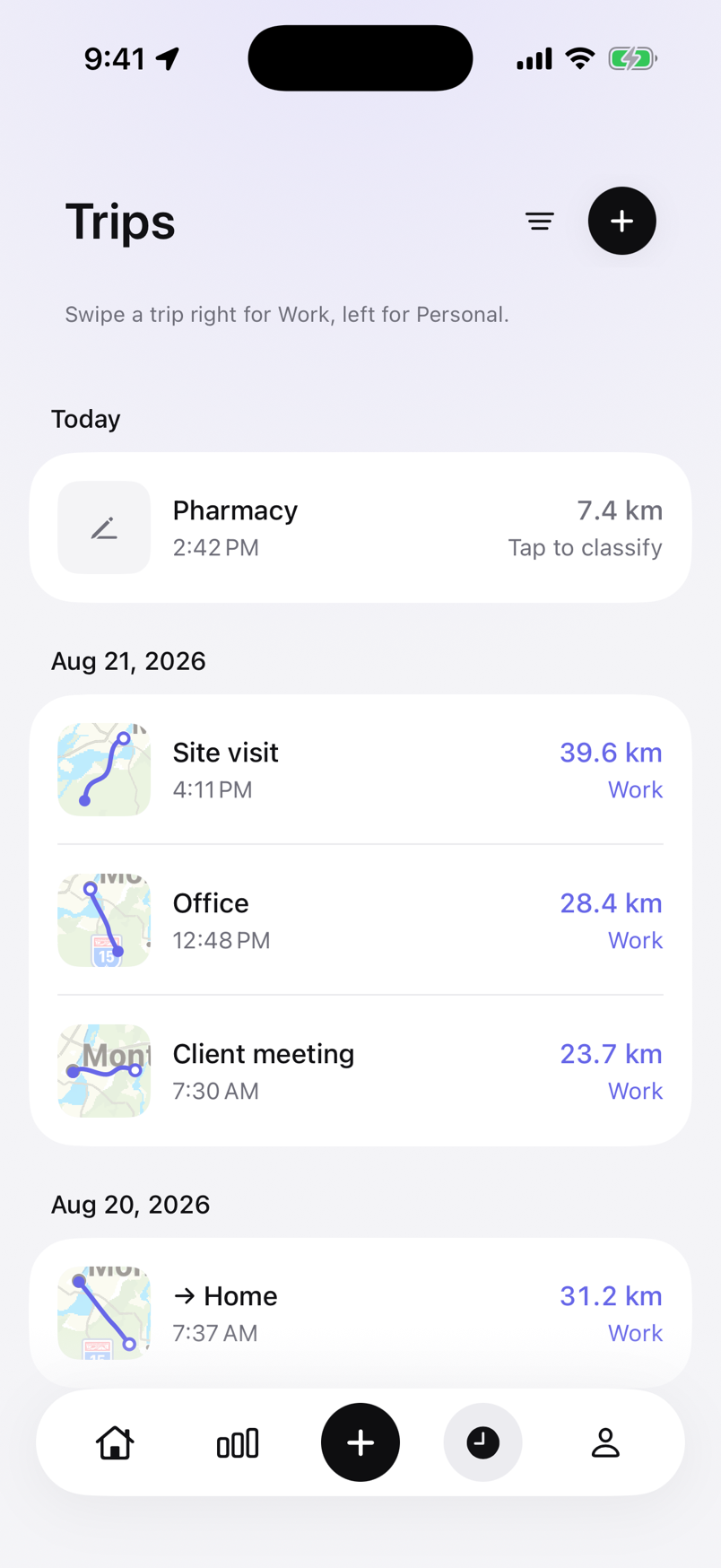
A day on the road
A day of service calls:
- WorkHome to a panel upgrade in the suburbs
- WorkPanel upgrade to the electrical wholesaler
- WorkWholesaler to a service call downtown
- WorkService call to a rough-in on a new build
- PersonalNew build to the gym before going home
The wholesaler run is the trip most often left out, and on a busy week it can be a fifth of the business kilometres.
What counts as business driving
In the log as Work
- Service calls and emergency call-outs
- Wholesaler and supply runs
- Quotes and site visits before a job
- Inspections you attend with the inspector
- Return trips to finish or correct work
Not business
- Home to a contractor’s shop you report to as an employee
- Personal stops between calls
- Driving the van for yourself on weekends
What the log is worth
A worked example for a self-employed driver in each country. Your numbers will differ; the method is the same.
Canada · self-employed
20,000 business km out of 28,000 km in total is 71.4% business use. Applied to $12,000 of car costs for the year, that is
$8,571
Deducted on the T2125. There is no per-kilometre deduction for the self-employed: it is a share of real costs, and the log proves the share.
The CRA on motor vehicle expensesUnited States · self-employed
12,500 business miles at the IRS standard rate of 76¢ (Jul 1 to Dec 31, 2026) is
$9,500
Deducted on Schedule C if you use the standard mileage rate. Business parking and tolls go on top.
Schedule C instructionsYour vehicle
Electricians usually drive a van or an SUV with shelving and stock, and many use it personally too. Running costs are deducted as the business share. The purchase price goes through capital cost allowance; the CCA guide uses a self-employed electrician’s $46,000 SUV as its example.
Expenses to keep with the log
- Fuel or charging
- Parking at downtown service calls
- Tolls
- Insurance, licence and registration, as the business share
- Maintenance, tires and repairs
What Odie does
- Starts a trip when your vehicle’s Bluetooth connects and you are moving, and ends it when you park.
- Asks Work or Personal from the lock screen, and suggests the answer after the same route twice.
- Keeps fuel, charging, parking and toll receipts next to the trips.
- Builds the year report: summary, monthly and per-client totals, expenses, the trip log and the odometer readings.
Add the client or the job number to a trip, and the year report totals kilometres per client. If you bill travel time or distance, that table is the backup. See a sample year report (PDF)
Questions
I work as a subcontractor for a larger shop. Is that self-employed driving?
If you invoice the shop as a business and report the income on the T2125 or Schedule C, the business-use rules for the self-employed apply. If you are on the shop’s payroll, you are an employee, and the question is whether the shop pays an allowance or signs a T2200. See employee allowance or self-employed deduction.
Do I need odometer readings if Odie logs the trips?
Yes, in Canada. The CRA asks for the odometer reading at the start and end of the year, because the business share is business kilometres over total kilometres. Odie keeps dated readings and compares them with the logged distance.
Does Odie work if my van has no Bluetooth?
Yes, with motion-only detection. It asks you to confirm each trip, because motion alone cannot tell your van from a ride in someone else’s vehicle. A small Bluetooth adapter in the van lets Odie start trips without asking.
Informational, not tax advice. Your accountant knows your situation.
Guides
-
Capital cost allowance for a vehicle in Canada
How a vehicle's purchase price turns into a yearly deduction on Form T2125, the $39,000 line that sets the class, and what changes for an electric one.
-
Is driving to work deductible in Canada? The CRA rule
Home to your regular workplace is personal. What the CRA counts as business driving instead, a worked example, and how to log trips so the split holds up.
-
Odometer readings for a CRA mileage log
Why the CRA asks for odometer readings at the start and end of the year, how two readings turn a log into a T2125 percentage, and a monthly check for gaps.
-
Claiming EV charging as a vehicle expense (CRA)
How electricity fits into a business vehicle claim in Canada: what to record per charge, how to handle home charging, public receipts, and the charger itself.
Your next work trip can log itself.
Odie is on the App Store, free to start.