5. Report
One PDF in March.
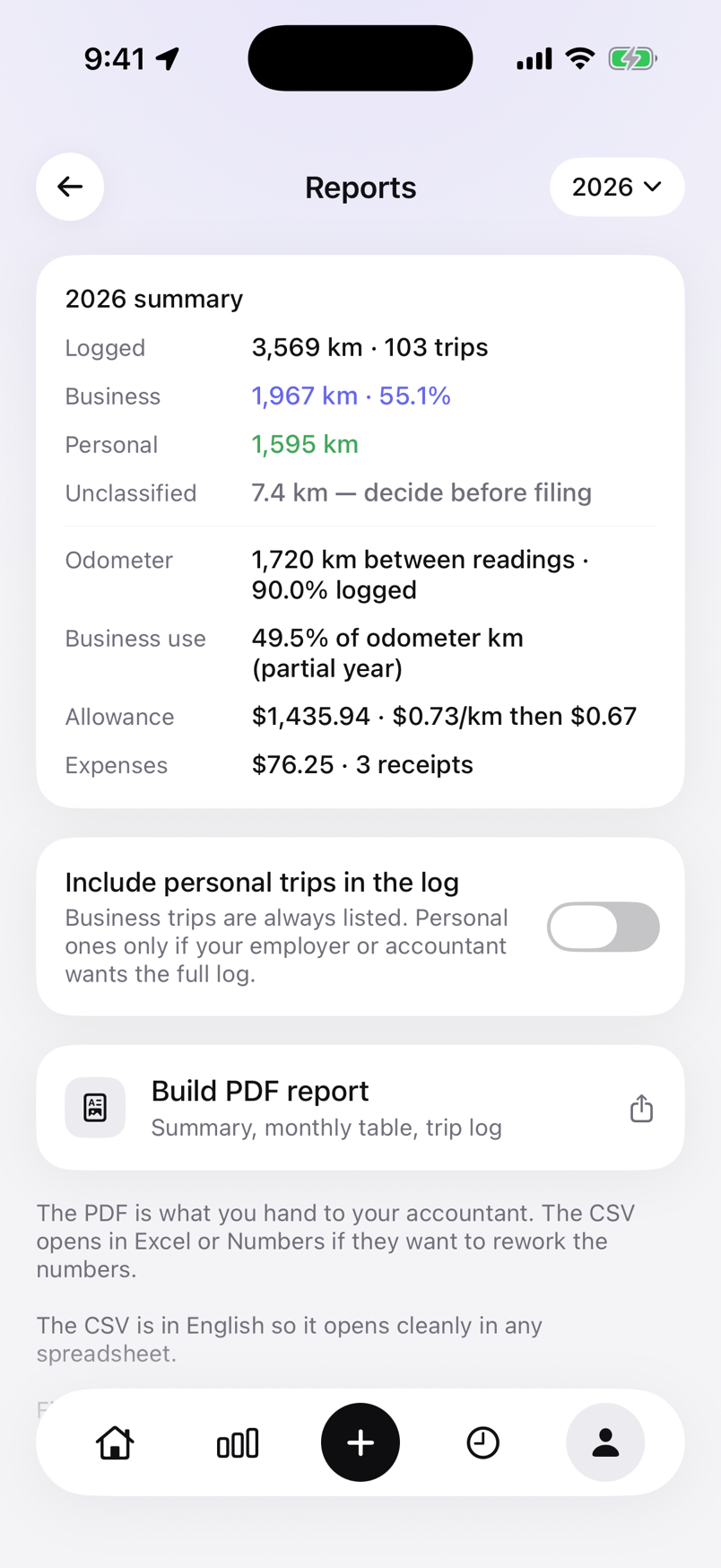
Pick a year and, if you have several cars, a vehicle. The PDF contains a summary, a monthly table, a per-client table, business expenses, the business trip log and the odometer bounds. The money line (Allowance under the CRA scheme, Deduction under the IRS scheme) shows the formula it used, distance at each rate that applied. Under the business-use method it also shows gross expenses, your share and the deductible amount. Personal trips are left out unless you switch them on. The footer of every page names the rate source (“Rates: CRA automobile allowance rates.” or “Rates: IRS standard mileage rates.”) and the records the scheme expects. The CSV is in English so it opens cleanly in any spreadsheet.
The same year exports as CSV. A separate full export writes every trip with coordinates, and a JSON backup holds trips, places, readings, expenses, vehicles and settings for moving to a new phone. Importing a backup merges by id, so nothing is duplicated.
Rates
Three schemes: CRA, IRS and custom, preselected from where you said you file taxes at setup. CRA and IRS carry a dated rate table for 2024 to 2026, taken from canada.ca and irs.gov and checked on August 23, 2026. Canada: the CRA table has the two tiers (first 5,000 km per calendar year, then the rest, applied in date order across all vehicles) and a Territories switch that adds 4¢ to each tier for Yukon, the Northwest Territories and Nunavut. United States: the IRS table is per mile, knows the two 2026 periods, carries the medical and charity rates for trips with those purposes, and adds parking and tolls on business trips on top of the standard rate. Each trip is priced at the rate in force on its date, so a 2025 report uses the 2025 figures, and the report names the rate it used, such as “CRA rate, 2026 tiers” or “IRS rate, Jul to Dec 2026”. If your employer pays a different rate, an override replaces the current year’s rate only, with one field per period in a split year. The custom scheme takes your own rate per kilometre or mile, an optional second tier with its threshold, and a label.
Canada: kilometres times the CRA rate is an employer allowance estimate, not a deduction. Employees with a T2200 deduct actual costs times employment use, and the self-employed deduct actual costs times business km over total km on T2125, which is what the business-use method is for. United States: miles times the IRS rate, plus parking and tolls, is the deduction under the standard mileage method for the self-employed on Schedule C, and a reimbursement estimate for a W-2 employee, who cannot deduct mileage outside the four Form 2106 exceptions. Home and Trends show the figure as “Allowance estimate” under the CRA scheme or “Deduction estimate” under the IRS scheme, with the basis under it (“km × CRA allowance rate, 2026 tiers”, “mi × IRS standard rate, 2026”), and “Deduction estimate” under the business-use method in either. Currency can be CAD, EUR, GBP or USD. Distances are stored in metres, so switching between kilometres and miles loses nothing. The current official figures are on the CRA and IRS pages.