
Mileage log · Construction and trades
Mileage tracker for plumbers
A burst pipe at 2 a.m., a water heater install at nine, a parts run at noon. A plumber’s driving does not keep office hours, which is why a log written later misses so much of it. Odie records each drive from your van as it happens.

No account. Free for 40 automatic trips a month, no card.
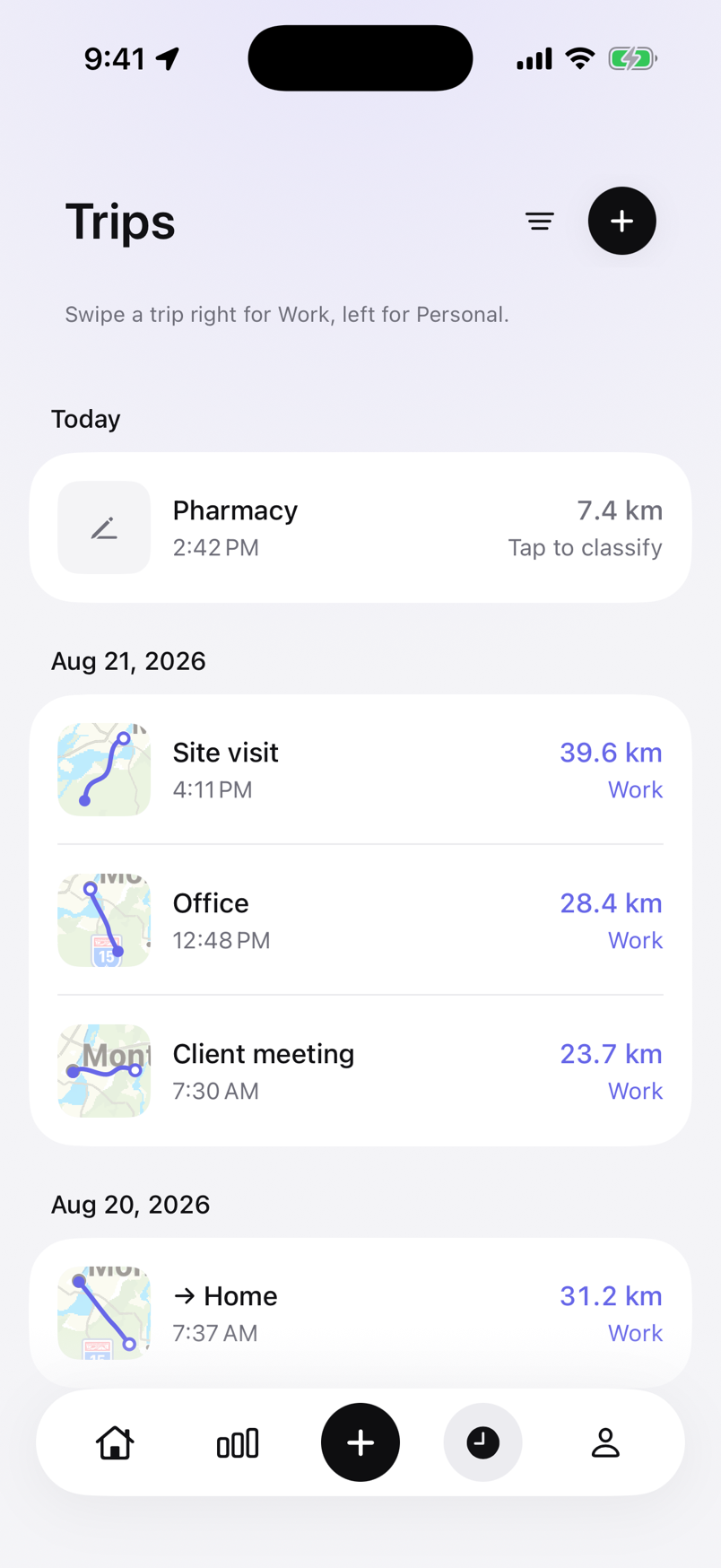
A day on the road
A day that started early:
- WorkHome to an emergency call for a burst pipe
- WorkEmergency call to the plumbing supplier for a fitting
- WorkSupplier to a water heater install
- WorkInstall to a quote for a bathroom renovation
- WorkQuote to home
A night call-out that is not in the log by morning is usually not in it at all.
What counts as business driving
In the log as Work
- Emergency and after-hours calls
- Installs and repairs at client homes and businesses
- Parts runs to the supplier during a job
- Quotes and inspections
- Return visits under warranty
Not business
- Home to a shop you report to every morning
- Personal stops on the way between jobs
- Personal use of the van
What the log is worth
A worked example for a self-employed driver in each country. Your numbers will differ; the method is the same.
Canada · self-employed
21,000 business km out of 29,000 km in total is 72.4% business use. Applied to $12,500 of car costs for the year, that is
$9,052
Deducted on the T2125. There is no per-kilometre deduction for the self-employed: it is a share of real costs, and the log proves the share.
The CRA on motor vehicle expensesUnited States · self-employed
13,000 business miles at the IRS standard rate of 76¢ (Jul 1 to Dec 31, 2026) is
$9,880
Deducted on Schedule C if you use the standard mileage rate. Business parking and tolls go on top.
Schedule C instructionsYour vehicle
Most plumbers drive a van that carries the stock, and many use it personally too. Running costs are deducted as the business share, and the van itself through capital cost allowance. In the United States, Schedule C asks whether the vehicle was available for personal use.
Expenses to keep with the log
- Fuel
- Parking and tolls at calls
- Insurance, licence and registration, as the business share
- Repairs and maintenance
- Loan interest or lease
What Odie does
- Starts a trip when your vehicle’s Bluetooth connects and you are moving, and ends it when you park.
- Asks Work or Personal from the lock screen, and suggests the answer after the same route twice.
- Keeps fuel, charging, parking and toll receipts next to the trips.
- Builds the year report: summary, monthly and per-client totals, expenses, the trip log and the odometer readings.
Odie starts the trip when the van’s Bluetooth connects and you are moving, whatever the hour. You tag the call when you park, or later from the trips list. See a sample year report (PDF)
Questions
Do emergency call-outs from home count?
When home is your place of business, a drive out to a client is business, at any hour. If you report to a shop as an employee, the question is whether your employer pays an allowance for those drives.
I missed a few weeks of logging. What now?
Rebuild them from invoices and your calendar, and say how you did it. A log kept at the time is stronger, so start Odie now and the gap stays small. See reconstructing a mileage log.
Can I add the supplier receipt to the trip?
Odie keeps fuel, charging, parking and toll receipts next to your trips. Parts receipts belong in your bookkeeping, not the vehicle log.
Informational, not tax advice. Your accountant knows your situation.
Guides
-
Is driving to work deductible in Canada? The CRA rule
Home to your regular workplace is personal. What the CRA counts as business driving instead, a worked example, and how to log trips so the split holds up.
-
Are parking and tolls deductible? (CRA)
Why parking and supplementary insurance skip the CRA's business-use percentage, what tolls fall back on instead, and how the employee route differs.
-
Reconstructing a mileage log after missing months
Honest guidance when the log has gaps: what evidence helps, what the CRA accepts and does not, and why prevention is cheaper than reconstruction.
Your next work trip can log itself.
Odie is on the App Store, free to start.