
Blog · · Updated
Are parking and tolls deductible? (CRA)
Why parking and supplementary insurance skip the CRA's business-use percentage, what tolls fall back on instead, and how the employee route differs.
An IT consultant working out of a home office in Mississauga, Ontario drives to a client’s building on King Street in Toronto twice a week, 34 km each way on Highway 407 ETR. He parks in a lot near the building at $16 a visit, close to 100 visits a year, and the 407 adds a toll to every one of those trips. Two costs that show up on the same drive, and the CRA does not treat them the same way.
What the percentage actually reduces
Most vehicle costs go through one calculation. The CRA’s guidance on calculating motor vehicle expenses says that “if you use a motor vehicle or a passenger vehicle for business and personal use, you can deduct only the part of the expenses that you paid to earn income,” worked out as business kilometres divided by total kilometres. Say the consultant’s fuel, insurance, maintenance and licence fees for the year add up to $6,000, and his logbook shows 8,000 of his 20,000 kilometres were business driving: 8,000 ÷ 20,000 × $6,000 works out to $2,400, or 40 percent. That percentage exists because those costs belong to owning and running the car for the whole year, personal driving included, so only the business share of them is deductible.
Parking gets its own sentence
Parking is not folded into that ratio. The same CRA page states plainly that “you can deduct the full amount of parking fees related to your business activities and supplementary business insurance for your motor vehicle or passenger vehicle.” Guide T4002 repeats the identical line in its chapter on business expenses. The consultant’s parking bill for the year, 100 visits × $16 = $1,600, is not multiplied by 40 percent: he deducts $1,600 on the T2125, not 40% × $1,600 = $640, a difference of $960. It is a cost tied to a specific business trip rather than to owning the car, and the CRA’s wording treats it that way: deduct the full amount, in the same category as the supplementary business insurance a lender or a client sometimes requires on top of a regular policy.
Tolls do not, so the general rule carries them
None of the CRA’s motor vehicle pages name tolls the way they name parking. Guide T4002’s expenses chapter opens with the broader rule instead: “As a rule, you can deduct any reasonable current expense you incur to earn income.” A 407 ETR charge is a cost of a specific business trip, the same as the parking spot at the other end of it, and nothing in the guide suggests reducing it by a business-use percentage built for costs the car carries all year. That reasoning follows from the general rule rather than from a named exception, and it is worth saying so plainly rather than dressing it up as a quoted line the guide does not contain. Where a rule is not spelled out, the safer move is to keep the toll receipt attached to the trip it paid for, the same way a mileage log attaches a distance to a date, and let an accountant confirm the treatment for your return.
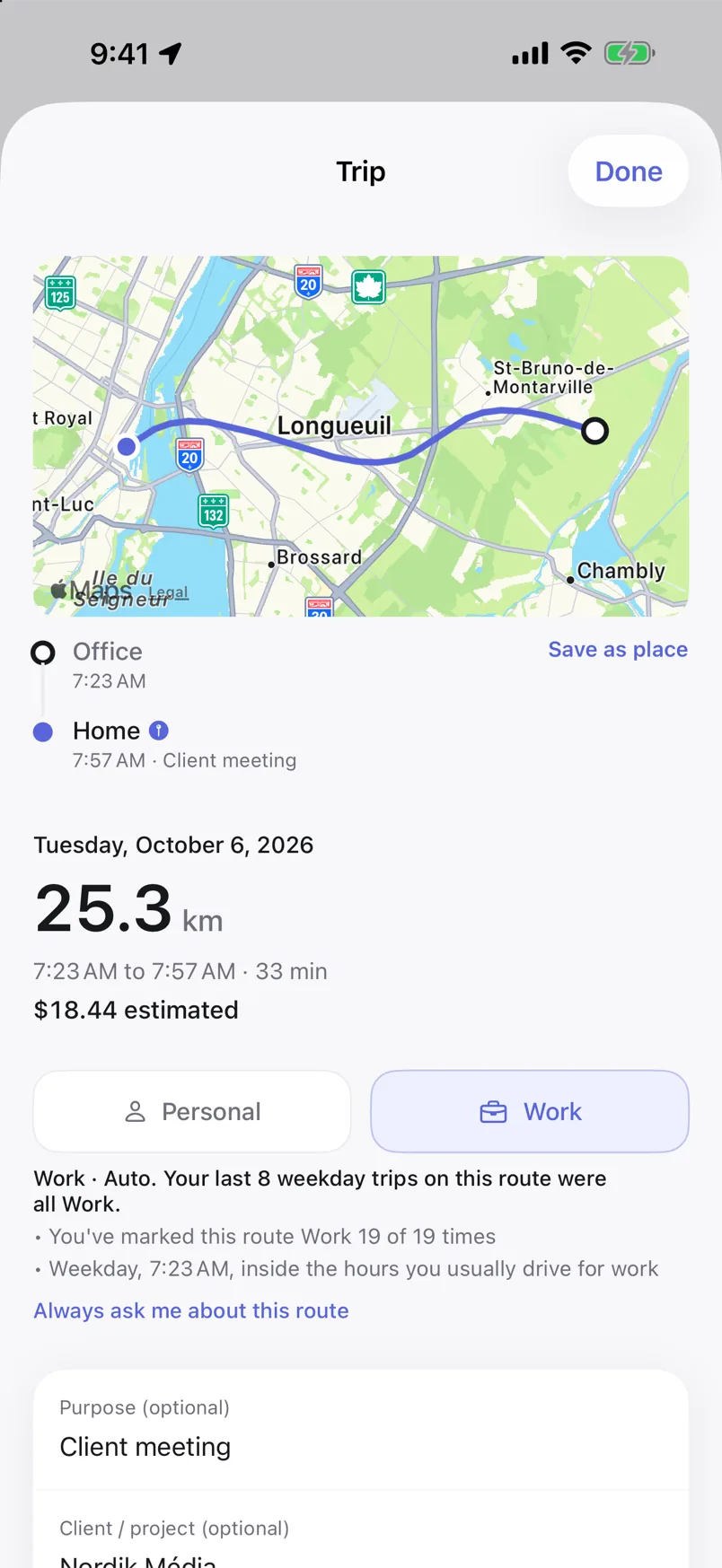 A logged trip with a receipt attached, so a parking or toll charge stays tied to the drive that produced it.
Odie keeps that pairing without anything typed after the fact. Each King Street drive is recorded when the car starts moving, and the parking or toll charge goes on that same trip as an expense, category parking or toll, with a photo of the receipt. The self-employed mileage log page shows how the rest of the year is kept.
The employee route runs through a different form
An employee claiming vehicle expenses under a T2200 does not use the T2125 percentage at all, and Guide T4044 sets its own rule for parking. A commission employee “can deduct parking costs related to earning your commission income,” and the same allowance applies to a salaried employee who is normally required to work away from the employer’s place of business. Both versions carry the identical limit: “you cannot deduct the cost of parking at your employer’s office, such as monthly or daily parking fees… These are personal costs.” An employee’s parking receipt from a client site is deductible; the receipt from the lot outside their own regular office is not. T4044 also keeps parking off the motor vehicle expense lines entirely: “Do not include parking costs as part of your allowable motor vehicle expenses. Enter them on the ‘Parking’ line on Form T777.” Tolls get no separate line in that guide either, which puts an employee in the same position as the self-employed consultant: no named rule, the receipt kept with the trip, and the reasonable-expense principle doing the work the specific wording does not.
The consultant’s own log settles the question before tax season does. In Odie, each of the year’s King Street trips carries its distance and route, and its parking and toll charges sit on the same trip as expenses, so the two dollar amounts that skip the 40 percent stay visible next to the one that does not. The sample year report shows where they end up: an expenses table with date, category and amount, beside the monthly kilometres and the business-use percentage.
Questions
Is business parking deductible in full or only the business-use percentage?
In full. The CRA says you can deduct the full amount of parking fees related to your business activities, so 100 visits at $16 is $1,600 on the T2125, not 40% of it.
Are highway tolls deductible for the self-employed in Canada?
The CRA’s motor vehicle pages do not name tolls. Guide T4002’s general rule lets you deduct any reasonable current expense you incur to earn income, so keep each toll receipt with the trip it paid for and have an accountant confirm the treatment.
Can an employee deduct parking at their own office?
No. Guide T4044 says parking at your employer’s office, such as monthly or daily parking fees, is a personal cost. Deductible parking for an employee goes on the Parking line of Form T777, not with motor vehicle expenses.
Sources
- CRA: Calculating motor vehicle expenses (T2125)
- CRA: Guide T4002, Chapter 3 – Expenses
- CRA: Guide T4044, Employment Expenses
Every figure above is checked against the sources listed. How we check our facts. Not tax advice; your accountant knows your situation. Spotted an error? Tell us.