
Blog · · Updated
Form T2200: what to ask your employer for
What signing Form T2200 actually certifies, the two conditions that have to be true before your employer will sign it, and what a mileage log still has to show.
A field rep based in Gatineau covers construction sites and offices across the Outaouais in her own Honda CR-V, close to 22,000 km a year. Her employer pays no per-kilometre allowance and no gas card. She wants to deduct the gas, the insurance, the lease payments, on her own return. Say 16,500 of her 22,000 km are for work and the car costs $10,400 a year to run: 16,500 ÷ 22,000 = 75%, and 75% × $10,400 = $7,800 of employment expenses. None of that reaches line 22900 until one document exists: Form T2200, signed by her employer.
What signing it actually means
The CRA’s page for the form puts the mechanism plainly: “the t2200 form must be completed by employers in order for their employees to deduct employment expenses from their income.” The Employers’ Guide to Taxable Benefits and Allowances is more precise about what the signature covers: “by signing the form, you are only certifying that the employee met the conditions of employment and had to pay for the expenses under their employment contract.” An employer signing T2200 is not doing the employee a favour. They are confirming something that was either already true of the job or was not.
The two conditions that have to hold before you ask
The CRA’s line 22900 guidance sets out the test: “your employment contract required you to pay the expenses” and “you did not receive an allowance for them, or the allowance you received is included in your income.” For a vehicle specifically, its guide to employment expenses adds the sharper version: “under your contract of employment, you had to pay your own motor vehicle expenses,” and it closes the loophole in the other direction too: “you are not considered to have paid your own motor vehicle expenses if your employer reimburses you or you refuse a reimbursement or reasonable allowance from your employer.” For the rep in Gatineau, both conditions hold: her contract requires her own car, and nothing comes back from her employer to cover it.
Why an employer says no
Most refusals trace back to one of those two conditions not being true, not to an employer being difficult. A job that does not actually require a personal vehicle, an office role with occasional errands run in a company car, say, gives the employer nothing accurate to certify. Neither does a job where a reasonable per-kilometre allowance is already paid: the CRA’s employer guide treats such an allowance as excluded from the employee’s income in the first place, which is also why the same kilometres cannot then be deducted a second time as an expense. We laid out that fork, allowance against deduction, with a full worked example, in employee allowance or self-employed deduction. The commute itself never enters either path: the line 22900 guidance is direct that employees “cannot deduct the cost of travel to and from work.”
What the form does not replace
A signed T2200 gets the expense into the calculation. It does not do the calculation. The CRA’s guide to employment expenses still asks for a record of each vehicle used for employment, showing both the total kilometres driven and the kilometres driven for employment purposes, and for a daily record of expenses with receipts kept alongside it. Its motor vehicle page for line 22900 is specific about what each trip’s entry needs: the date, the destination, the purpose, and the number of kilometres, plus an odometer reading at the start and again at the end of the year. None of that becomes optional because the form exists. It is what makes the number on the form defensible if the return is ever reviewed. The full mechanics of that log, the four fields and the odometer bounds, are in what the CRA wants in a mileage logbook.
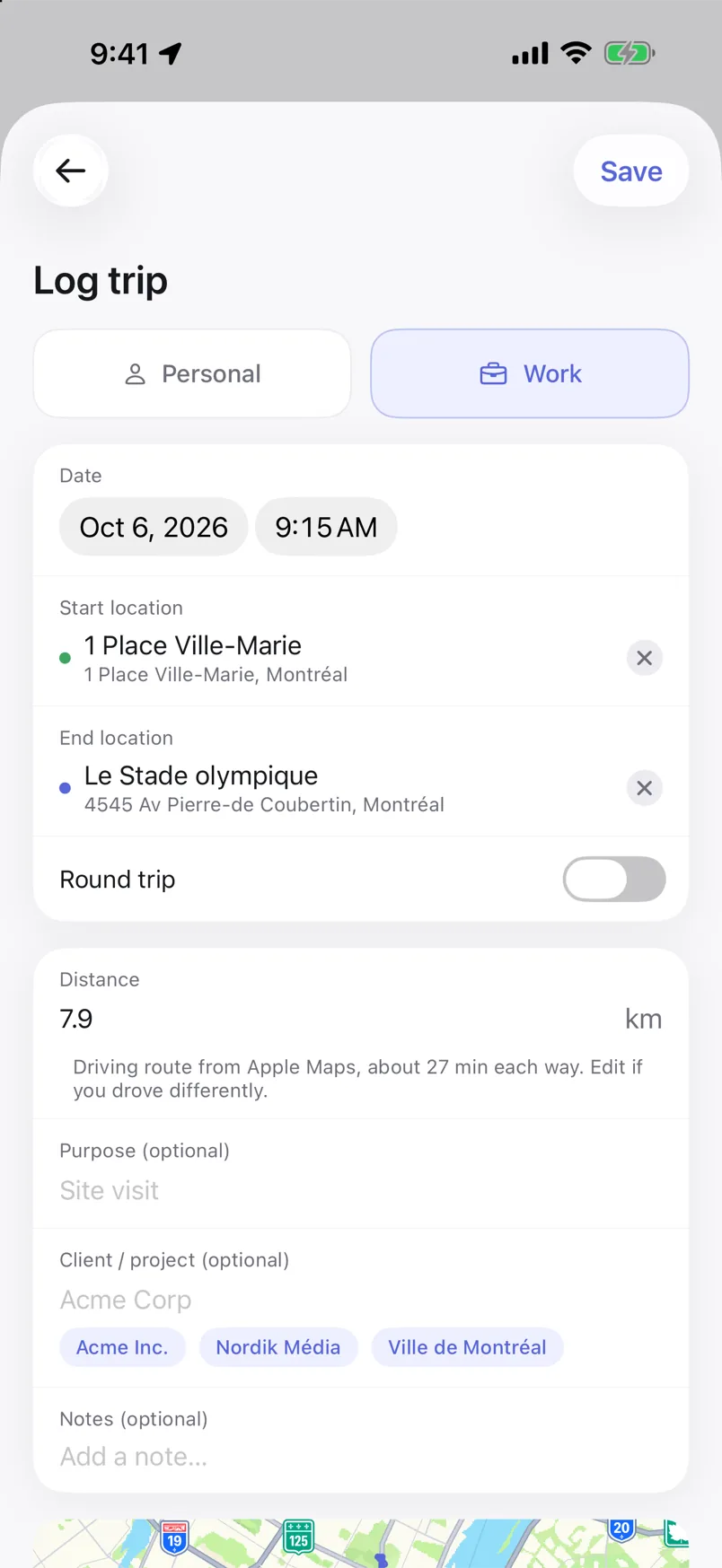 Each recorded trip carries a date, a route and a distance, the fields a T2200 claim still needs behind it.
The expense side can sit in the same log. Odie records gas, maintenance, parking and other costs with a receipt photo, next to trips it records by itself with their date, route and distance; the mileage log template has the same trip columns, and Odie fills them in as you drive. Everything is stored on the phone and in your own private iCloud database, and none of it is sent to us.
Where T2200 actually lands
The expenses themselves flow through Form T777, Statement of Employment Expenses, and only the total reaches the return: the CRA’s guidance says to enter on line 22900 the allowable amount from the total expenses line of Form T777. T2200 itself is not attached to the return as filed. It is kept with the employee’s records, under the same retention period as the rest of a logbook: six years from the end of the tax year the claim covers. If the CRA asks, T2200 and the vehicle log answer the same question from two directions: the job required the cost, and here is what the cost actually was.
Odie keeps the second half of that answer without extra effort. It records each trip’s date, route and distance as you drive, asks whether it was Work or Personal, and keeps a dated odometer reading you can pull at year end. What your employer signs is still on them to provide, but the log behind it does not have to wait until March. The sample year report shows the year it builds: monthly business and personal kilometres, the expenses and the odometer bounds.
Questions
Can my employer refuse to sign a T2200?
Signing only certifies that you met the conditions of employment and had to pay the expenses under your contract. If the job does not require your own vehicle, or already pays a reasonable per-kilometre allowance, there is nothing accurate for the employer to certify.
Do I attach Form T2200 to my tax return?
No. The expenses go on Form T777 and only its total reaches line 22900; T2200 is kept with your records for six years from the end of the tax year the claim covers.
Can I deduct car expenses if my employer pays a per-km allowance?
Only if the allowance is included in your income. The CRA also says you have not paid your own motor vehicle expenses if your employer reimburses you or you refuse a reasonable allowance (allowance or deduction, worked through).
Is my commute deductible with a T2200?
No. The CRA’s line 22900 guidance says employees cannot deduct the cost of travel to and from work.
Sources
- CRA: Form T2200, Declaration of Conditions of Employment
- CRA: Employment expenses (T4044)
- CRA: Motor vehicle expenses, line 22900
- CRA: Line 22900, other employment expenses
- CRA: Employers' guide, taxable benefits and allowances (T4130)
Every figure above is checked against the sources listed. How we check our facts. Not tax advice; your accountant knows your situation. Spotted an error? Tell us.