
Blog · · Updated
Mileage log with two cars for one business
A cargo van at 86% business use and a sedan at 20% cannot share one logbook. Why the CRA wants each vehicle's kilometres and costs kept apart.
A self-employed electrician in Barrie, Ontario runs two vehicles: a cargo van for job sites and a ten-year-old sedan for permit runs and quotes at clients’ homes. On December 31 the van’s odometer reads 22,120 km since January 1, the sedan’s 13,500 km. Add the two together and the year comes to 35,620 km, which is exactly the number the CRA does not want on a return.
A record per vehicle, not per business
The CRA’s small business guide states the rule without qualification: “If you use more than one motor vehicle for your business, keep a separate record for each vehicle that shows the total and business kilometres you drive, and the cost to run and maintain each vehicle. Calculate each vehicle’s expenses separately.” That means two odometer pairs, not one. The CRA’s guidance on motor vehicle records is specific about the reading itself too: record the odometer of each vehicle at the start and end of the fiscal period, so the van’s 22,120 km and the sedan’s 13,500 km each need their own start and end figures on file, not a combined total that happens to add up.
The reason is not paperwork for its own sake. The van and the sedan are driven for almost opposite purposes. Nineteen thousand of the van’s kilometres are job-site runs and supply pickups; the rest is the drive home. Twenty-seven hundred of the sedan’s kilometres are trips to the township office for permits and to clients’ driveways for estimates; the other 10,800 is groceries and the school run. Merge the two logs and the business share of the combined 35,620 km comes out to about 61%, a number that describes neither vehicle. It also moves the deduction. The van cost $11,050 to run this year and the sedan $3,800. Worked out separately (below), they give $9,491 + $760 = $10,251 on the T2125. Merged, 21,700 ÷ 35,620 × $14,850 gives $9,047, which is $1,204 less, and it is not the calculation the CRA describes.
Why the percentages diverge
Calculated separately, the van comes to 19,000 ÷ 22,120 km, or about 86% business use. The sedan comes to 2,700 ÷ 13,500 km, exactly 20%. The CRA’s own worked example for a single vehicle follows the same shape: business kilometres divided by total kilometres, multiplied by that vehicle’s costs, gives the deductible amount. Applied here, the van’s $11,050 in fuel, insurance, maintenance and lease payments for the year produces a claim of $9,491 at that 86% rate. The sedan’s $3,800 in fuel, insurance and maintenance produces exactly $760 at 20%. Averaging the two vehicles’ percentages first and applying it to the combined cost would land nowhere near either figure.
 Each vehicle keeps its own trips, so its odometer bounds and business-use percentage never mix with the other car’s.
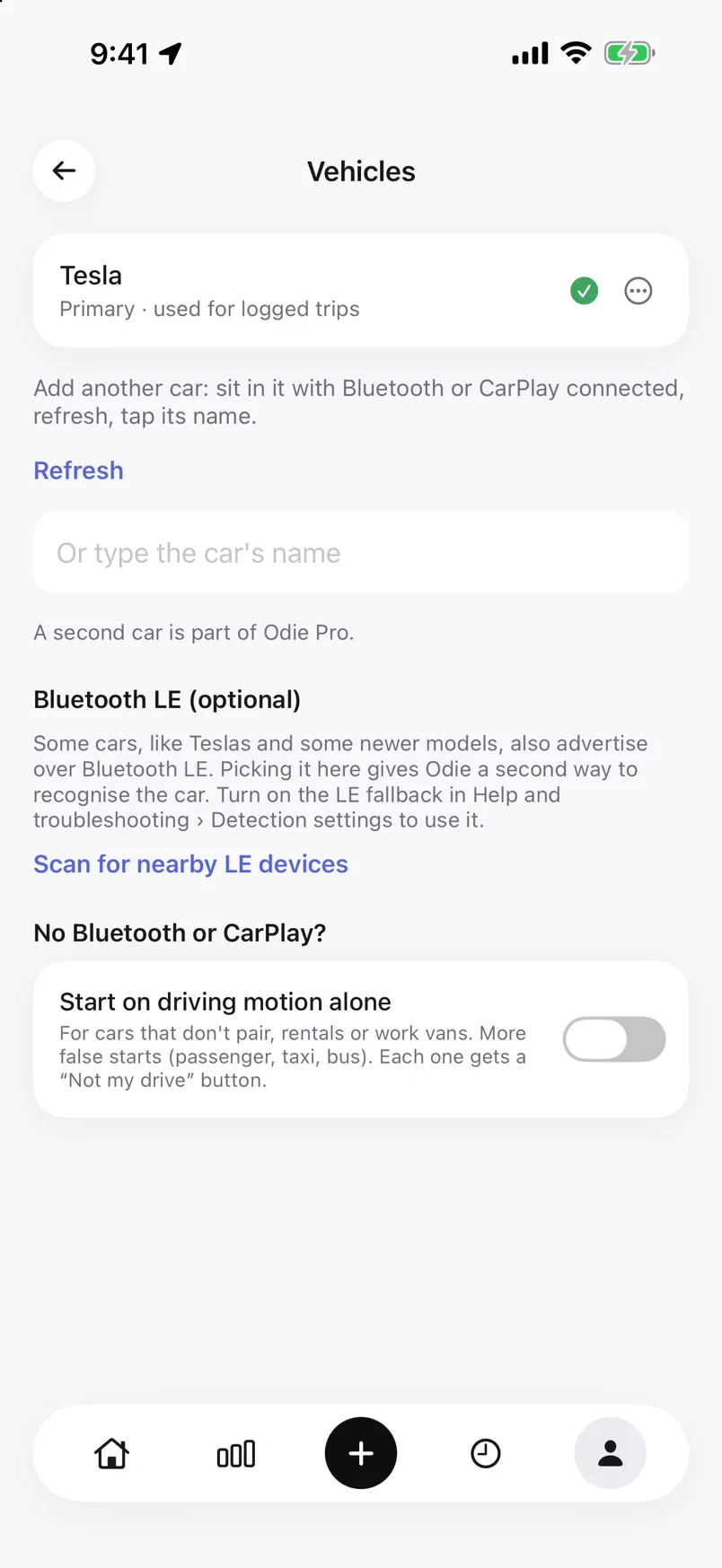
The vehicle column is the one people forget to fill in. When each vehicle pairs with the phone, Odie recognises it by its hands-free Bluetooth name and the trip records which one made it, so the van’s job-site runs and the sedan’s permit runs are sorted as they are driven. More than one car is part of Odie Pro; the self-employed mileage log page lists what the free version covers.
One line on the return
The two calculations stay separate on paper and then meet on the return. Deductible motor vehicle costs, licence and registration fees, fuel, insurance, loan interest, maintenance and leasing among them, go on line 9281 of Form T2125, and the van’s $9,491 and the sedan’s $760 are added into that single figure once each has been worked out on its own. Capital cost allowance, if either vehicle was bought rather than leased, is a separate calculation again, tracked per vehicle in its own CCA class and reported on a different line, so a purchased van and a purchased sedan each carry their own undepreciated balance even after their operating costs have been combined.
What keeps the logs from mixing
A logbook that records date, destination, purpose and kilometres for every trip only prevents the two vehicles from blurring together if it also records which vehicle made the trip. A permit-office run logged without a vehicle tag could just as easily belong to the van’s ledger as the sedan’s, and once that happens the two odometer pairs stop matching the two logs. Odie records which car a trip belongs to and keeps each vehicle’s trips, odometer readings and business-use percentage apart automatically, so the van’s 86% and the sedan’s 20% are never computed from each other’s kilometres. The mileage log template has the same columns, with the vehicle next to the date; Odie fills them in as you drive. The sample year report shows one vehicle’s year: the vehicle’s name, its opening and closing odometer, and business kilometres and business percentage by month.
Questions
Do I need a separate mileage log for each car?
Yes. The CRA says that if you use more than one motor vehicle for your business, you keep a separate record for each vehicle with its total and business kilometres and its costs, and calculate each vehicle’s expenses separately.
Can I combine two vehicles into one business-use percentage?
No. In the example above, merging a van at 86% and a sedan at 20% gives about 61% and a $9,047 deduction, $1,204 less than the $10,251 the two separate calculations produce.
Where do two vehicles go on the T2125?
Each vehicle’s deductible costs are worked out on their own, then added into the single motor vehicle expenses figure on line 9281. Capital cost allowance is calculated per vehicle and reported on a different line.
Can a mileage app track two cars separately?
Odie does with Odie Pro: it recognises each car by its hands-free Bluetooth name and records which car made each trip. The free tier covers one car.
Sources
- CRA: Motor vehicle records
- CRA: Calculating motor vehicle expenses (T2125)
- CRA: T4002 guide, Business expenses (Chapter 5, Motor vehicle expenses)
Every figure above is checked against the sources listed. How we check our facts. Not tax advice; your accountant knows your situation. Spotted an error? Tell us.