
Mileage log · Health and care
Mileage tracker for home care workers and PSWs
Home care is short drives all day: a morning visit, a medication check, a bath, an afternoon visit across town. Six or eight trips of a few kilometres each are exactly the ones nobody writes down. Odie logs each one by itself.

No account. Free for 40 automatic trips a month, no card.
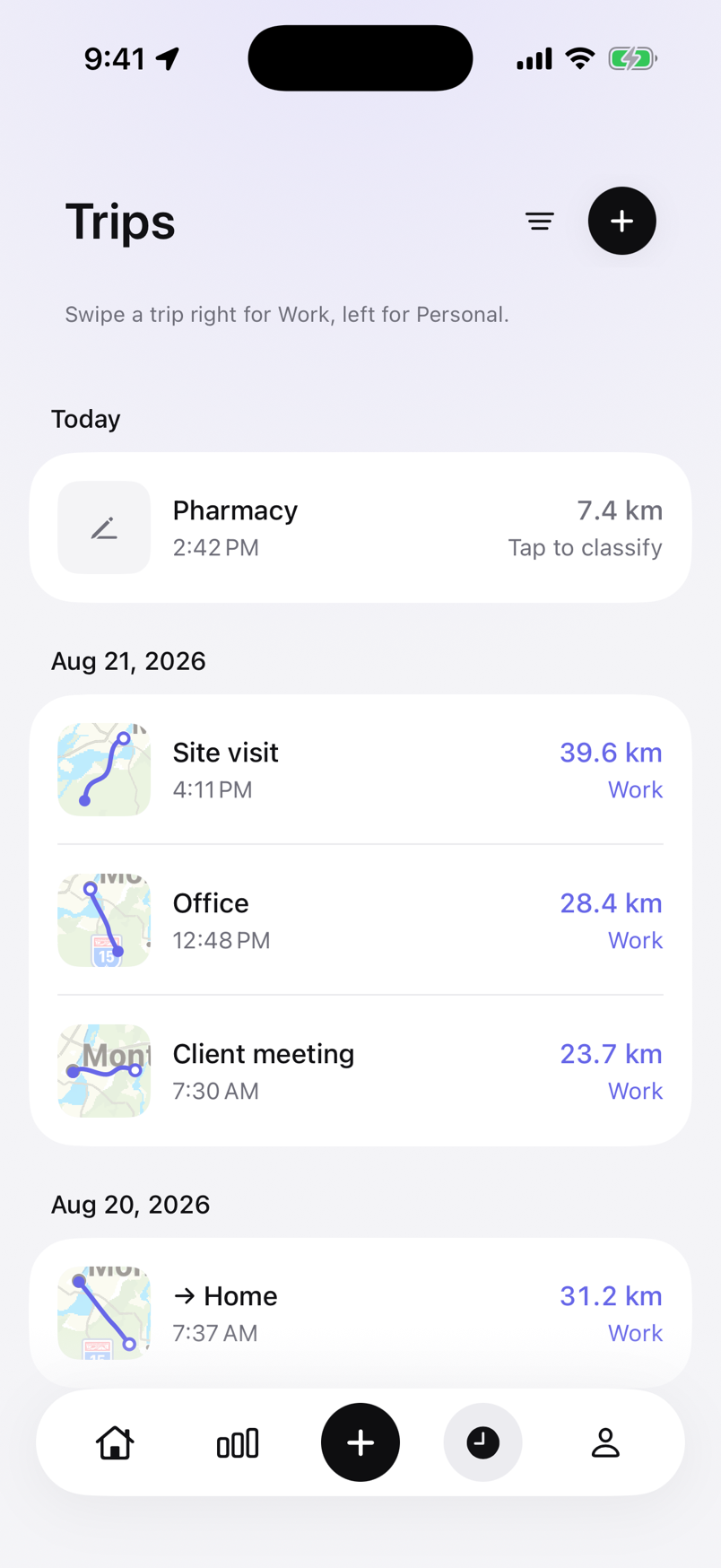
A day on the road
A weekday with five clients:
- WorkHome to the first client’s morning routine
- WorkFirst client to a medication check
- WorkMedication check to a bathing visit
- WorkBathing visit to the pharmacy to pick up a client’s prescription
- WorkPharmacy to the last client, then home
Whether the first and last legs count depends on how you work. The trips between clients count either way.
What counts as business driving
In the log as Work
- Drives between client homes
- Errands for a client, like a pharmacy pickup
- Driving a client to an appointment, if it is part of the work
- Trips to the agency office for meetings during the day
Not business
- Home to the agency office you report to
- Personal stops between visits
- Driving home after the last visit when you started at the agency
What the log is worth
A worked example for a self-employed driver in each country. Your numbers will differ; the method is the same.
Canada · self-employed
15,000 business km out of 22,000 km in total is 68.2% business use. Applied to $8,500 of car costs for the year, that is
$5,795
Deducted on the T2125. There is no per-kilometre deduction for the self-employed: it is a share of real costs, and the log proves the share.
The CRA on motor vehicle expensesUnited States · self-employed
9,000 business miles at the IRS standard rate of 76¢ (Jul 1 to Dec 31, 2026) is
$6,840
Deducted on Schedule C if you use the standard mileage rate. Business parking and tolls go on top.
Schedule C instructionsEmployee paid per kilometre (Canada)
The same 15,000 km paid at the CRA rate for 2026 (73¢, then 67¢) is a tax-free allowance of
$10,350
No deduction on top of a reasonable allowance. The log is what justifies the kilometres.
Your vehicle
Most home care workers drive their own small car. If you work for an agency, it may pay a per-kilometre allowance, and then the log is what justifies the kilometres you claim. If you are self-employed, you deduct the business share of real car costs instead.
Expenses to keep with the log
- Fuel
- Parking at clients’ buildings
- Insurance, as the business share if self-employed
- Maintenance
What Odie does
- Starts a trip when your vehicle’s Bluetooth connects and you are moving, and ends it when you park.
- Asks Work or Personal from the lock screen, and suggests the answer after the same route twice.
- Keeps fuel, charging, parking and toll receipts next to the trips.
- Builds the year report: summary, monthly and per-client totals, expenses, the trip log and the odometer readings.
Short trips are where automatic logging pays off most. Odie starts each one when your car connects and you move, so a 3 km hop between clients is in the log without a note. See a sample year report (PDF)
Questions
My agency pays per kilometre. Do I still need a log?
Yes. A reasonable per-kilometre allowance is paid on kilometres actually driven for work, and the log is what you and the agency show if the CRA asks. In 2026 the CRA rate is 73¢ for the first 5,000 km and 67¢ after. See employee allowance or self-employed deduction.
My agency pays nothing for driving. Can I deduct it?
Possibly, as an employee, if you were required to work away from the employer’s place of business and pay your own car costs, and the employer signs a T2200. See what to ask your employer for the T2200.
Are the drives between clients business if I am self-employed?
Yes. A drive from one client to the next serves the business. The question is only the first and last leg of the day, which depends on whether home is your place of business.
Informational, not tax advice. Your accountant knows your situation.
Guides
-
CRA mileage allowance vs self-employed deduction
A T2200 employee and a T2125 sole proprietor account for the same driving in different ways. The two systems side by side, with one worked example.
-
Form T2200: what to ask your employer for
What signing Form T2200 actually certifies, the two conditions that have to be true before your employer will sign it, and what a mileage log still has to show.
-
CRA mileage logbook requirements
The full logbook, the simplified three-month sample, the 10-point rule with its formula, what each trip record needs, and how long to keep it.
Your next work trip can log itself.
Odie is on the App Store, free to start.