
Mileage log · Real estate and property
Mileage tracker for home inspectors
Two or three inspections a day, each at a different address, often an hour apart. A home inspector’s driving is almost all business, which makes the deduction large and the log important. Odie records each drive and where it ended.

No account. Free for 40 automatic trips a month, no card.
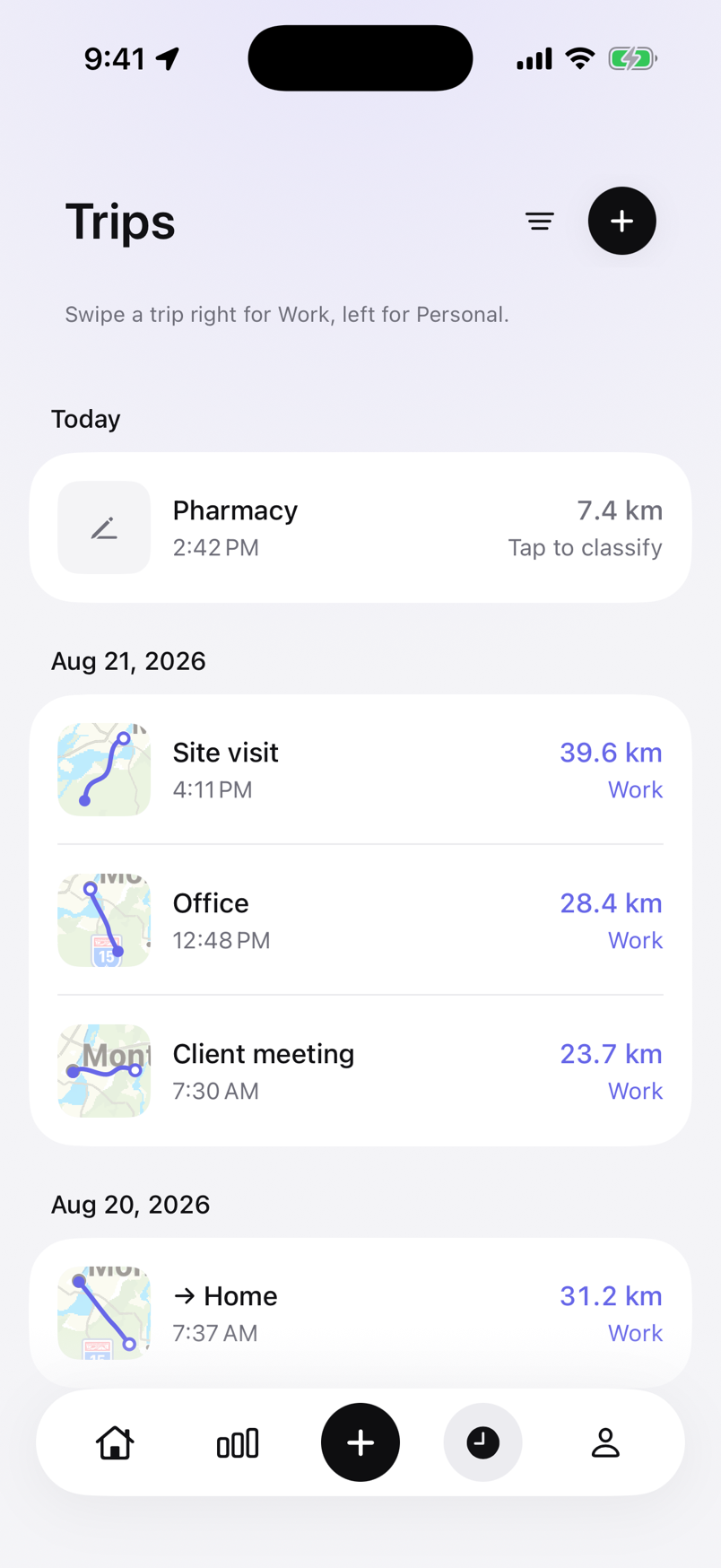
A day on the road
A Thursday with three inspections:
- WorkHome office to a pre-purchase inspection in the suburbs
- WorkInspection to a condo inspection downtown
- WorkCondo to a pre-listing inspection in the next town
- WorkLast inspection to home to write the reports
With a home office as the place of business and no other workplace, a day like this can be all business kilometres.
What counts as business driving
In the log as Work
- Drives to each inspection address
- Re-inspections and follow-up visits
- Meetings with agents or clients at a property
- Supply runs for equipment and tools
Not business
- Personal stops between inspections
- Personal and family driving in the same car
- Home to an office you rent and report to daily
What the log is worth
A worked example for a self-employed driver in each country. Your numbers will differ; the method is the same.
Canada · self-employed
19,000 business km out of 26,000 km in total is 73.1% business use. Applied to $9,800 of car costs for the year, that is
$7,162
Deducted on the T2125. There is no per-kilometre deduction for the self-employed: it is a share of real costs, and the log proves the share.
The CRA on motor vehicle expensesUnited States · self-employed
12,000 business miles at the IRS standard rate of 76¢ (Jul 1 to Dec 31, 2026) is
$9,120
Deducted on Schedule C if you use the standard mileage rate. Business parking and tolls go on top.
Schedule C instructionsYour vehicle
Inspectors usually drive their own car or SUV with ladders and equipment. Because the business share is high, an odometer reading at the start and end of the year matters: it is the denominator the share is calculated on.
Expenses to keep with the log
- Fuel
- Parking at downtown condo inspections
- Tolls
- Insurance, licence and registration, as the business share
- Maintenance and repairs
What Odie does
- Starts a trip when your vehicle’s Bluetooth connects and you are moving, and ends it when you park.
- Asks Work or Personal from the lock screen, and suggests the answer after the same route twice.
- Keeps fuel, charging, parking and toll receipts next to the trips.
- Builds the year report: summary, monthly and per-client totals, expenses, the trip log and the odometer readings.
The destination of each trip is in the log, so it lines up with your inspection reports without retyping addresses. See a sample year report (PDF)
Questions
My business share is over 80%. Will that be questioned?
A high share is normal for work that is mostly driving to addresses. What supports it is the log: each business trip with date, destination, purpose and distance, plus odometer readings at the start and end of the year.
Does the CRA accept a sample instead of a full year?
After one full year of records, the CRA accepts a three-month sample logbook in later years if the business use stays within 10 percentage points of the base year. See what the CRA wants in a logbook.
What does the IRS ask for?
For each business use: the date, the destination, the business purpose and the miles, recorded at or near the time. See IRS adequate records.
Informational, not tax advice. Your accountant knows your situation.
Guides
-
CRA mileage logbook requirements
The full logbook, the simplified three-month sample, the 10-point rule with its formula, what each trip record needs, and how long to keep it.
-
Odometer readings for a CRA mileage log
Why the CRA asks for odometer readings at the start and end of the year, how two readings turn a log into a T2125 percentage, and a monthly check for gaps.
-
IRS adequate records for car expenses
Publication 463's own worksheet for a mileage log, why filling it in once a week still counts as timely, and how one logged week can stand for a month.
Your next work trip can log itself.
Odie is on the App Store, free to start.