
Blog · · Updated
IRS adequate records for car expenses
Publication 463's own worksheet for a mileage log, why filling it in once a week still counts as timely, and how one logged week can stand for a month.
A mobile dog groomer working out of Aurora, Colorado drives a converted cargo van between nine driveways on a busy Saturday, fewer on the weekdays she splits with school runs and vet drop-offs. A typical March week comes to 155 business miles, and at the 2026 standard rate that week alone is 155 × $0.725 = $112.38 of deduction on her Schedule C. Every one of those miles has to survive the same test if the IRS ever asks: is the record adequate. Publication 463 spells out what that word means, down to a worksheet the IRS prints for exactly this purpose.
What a record has to show
Publication 463 keeps the format loose: “You should keep the proof you need in an account book, diary, log, statement of expense, trip sheets, or similar record.” What it will not compromise on is the content. Its Table 5-1 lists what a car expense has to prove: “the cost of the car and any improvements, the date you started using it for business, the mileage for each business use, and the total miles for the year,” the date of each use, “your business destination,” and the business purpose. The publication even supplies its own worksheet for it, Table 5-2, “Daily Business Mileage and Expense Log,” with columns for the date, destination, business purpose, odometer readings at the start and stop of each trip, and miles that trip. Four fields and two odometer numbers, repeated every time the van leaves the driveway.
A week from the groomer’s log
Her bookings for the first week of March, logged the way Table 5-2 asks for it:
| Date | Destination | Purpose | Miles |
|---|---|---|---|
| Mon 3/2 | Centennial | 2 grooming appointments | 22 |
| Wed 3/4 | Parker | 4 grooming appointments | 31 |
| Fri 3/6 | Aurora, Parker | 6 grooming appointments | 44 |
| Sat 3/7 | Aurora | 9 grooming appointments (Saturday route) | 58 |
155 business miles that week, against 172 total once a Saturday grocery run and a personal errand are counted in, for a 90 percent business share.
Why a weekly entry still counts as timely
Nothing in Table 5-2 requires an entry after every driveway. Publication 463 sets the bar at “at or near the time of the expense or use,” then says plainly what that allows: “You don’t need to write down the elements of every expense on the day of the expense. If you maintain a log on a weekly basis that accounts for use during the week, the log is considered a timely kept record.” A log filled in Sunday night from the week’s appointment book meets that standard the same as one written stop by stop. What it protects against is the opposite habit, reconstructing April’s miles in the following February: “A timely kept record has more value than a statement prepared later when there is generally a lack of accurate recall.”
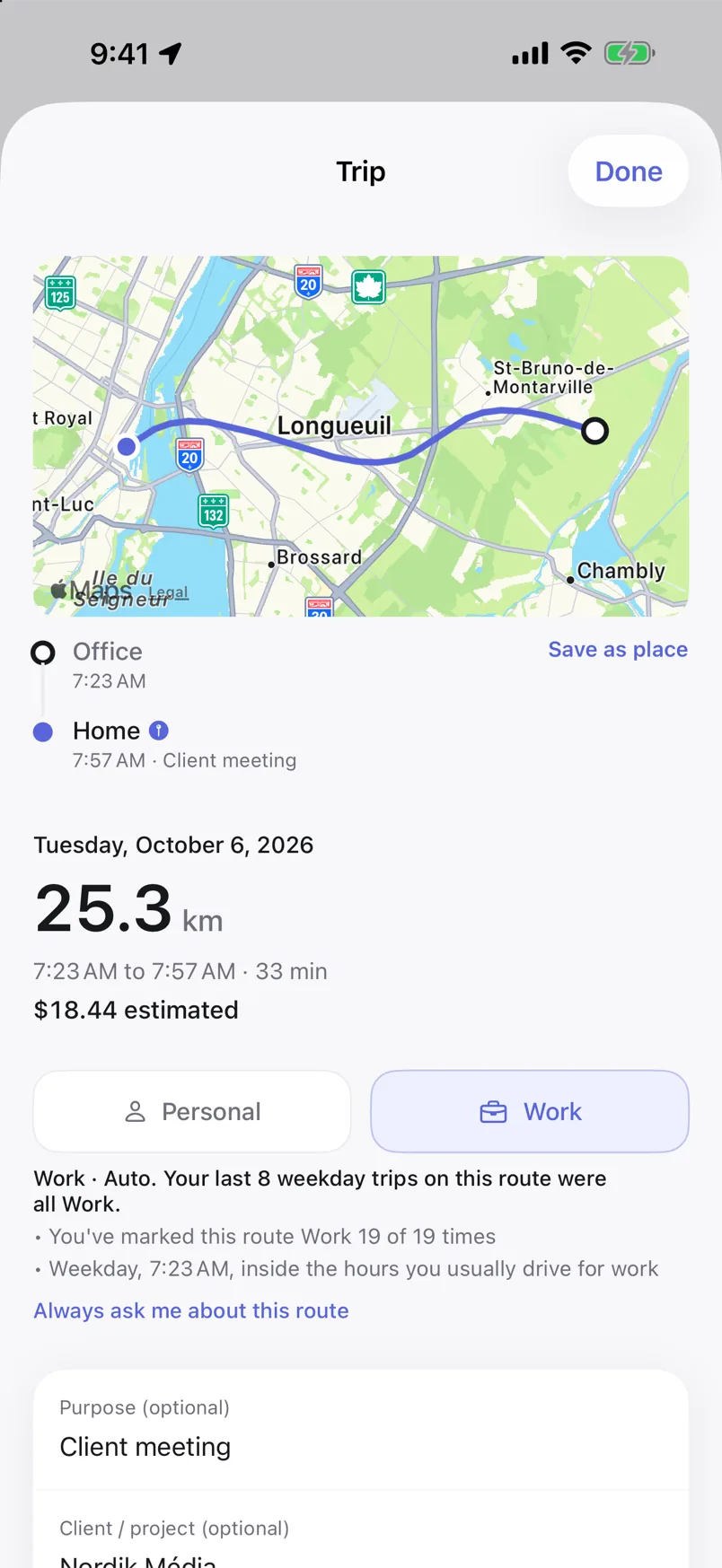 One trip’s record holding the fields Table 5-1 asks for: date, destination, purpose and distance.
The Sunday-night session can go away entirely. Odie starts and ends each trip by itself, records its date, route and distance, asks Work or Personal after the drive, and prices each business mile at the IRS rate in force on its date. Here is how Odie keeps a self-employed mileage log.
One logged week standing for the month
Publication 463 does not require every week logged this closely, only enough of them to be representative. “You can keep an adequate record for parts of a tax year and use that record to prove the amount of business or investment use for the entire year. You must demonstrate by other evidence that the periods for which an adequate record is kept are representative of the use throughout the tax year.” The IRS’s own example in that section is a business that logs the first week of each month and shows 75 percent business use, then points to invoices proving the same rate held in the weeks that were not logged. The groomer’s version of that second half is her booking software: it shows the same six-to-nine-stop pattern in the weeks of March she did not log by hand, which is what lets the first week’s 90 percent stand in for the rest of the month.
How long any of it has to survive
The retention rule is shorter than the recordkeeping rule: “Generally, this means you must keep records that support your deduction (or an item of income) for 3 years from the date you file the income tax return on which the deduction is claimed.” Depreciation is the exception inside that rule. If the van itself is being depreciated rather than run on the standard mileage rate, the business-use percentage behind that depreciation has to hold up for longer than three years, because “you must keep records of the business use of your car for each year of the recovery period,” and each year’s depreciation deduction depends on the ones logged before it.
Odie records the date, route and distance of every one of those driveways on its own, tags each trip Work or Personal with a swipe, and keeps dated odometer readings alongside them, so there is no first week of the month to single out for logging by hand: every week already looks like the sample one. The mileage log template has the fields Table 5-2 asks for; Odie fills them in as you drive. The sample IRS year report (PDF) shows what Odie Pro builds from them: a monthly table, the trip log and the odometer bounds. The IRS mileage calculator prices a week’s business miles at the current cents-per-mile rate once the log is in hand. The rate itself, and why it changed twice in 2026, is covered in why 2026 prices trips differently before and after July 1.
Questions
Do I have to log every trip the day I drive it for the IRS?
No. Publication 463 says a log kept on a weekly basis that accounts for use during the week is considered a timely kept record. What carries less weight is a statement prepared later, such as April’s miles reconstructed the following February.
What does an IRS mileage log need to include?
For each business use: the date, the destination, the business purpose and the miles. For the car: its cost, the date you started using it for business, and the total miles for the year; Table 5-2 in Publication 463 also has columns for the odometer at the start and end of each trip.
Can I log one week a month instead of the whole year?
Yes, if other evidence shows the logged periods are representative of the whole year. The IRS example logs the first week of each month and uses invoices to show the same business use held in the other weeks.
How long should I keep my mileage log for the IRS?
Generally 3 years from the date you file the return that claims the deduction. If you depreciate the car instead of using the standard mileage rate, keep the business-use records for each year of the recovery period.
Sources
- IRS: Publication 463, Travel, Gift, and Car Expenses
- IRS: Recordkeeping for small businesses and self-employed
Every figure above is checked against the sources listed. How we check our facts. Not tax advice; your accountant knows your situation. Spotted an error? Tell us.