
Blog · · Updated
Uber and DoorDash mileage deduction (IRS)
Why an Uber or DoorDash trip summary misses miles the IRS still counts, the $400 line that requires a return, and the 1099-K threshold that does not change it.
A driver in Columbus, Ohio spends a Tuesday shift in September running Uber and DoorDash at the same time: six rides, nine deliveries, home base in Clintonville with stops as far out as Dublin and Westerville. Uber’s weekly summary credits the shift with 41 miles, the distance between each pickup and each drop-off. The driver’s own log, running the whole time the app was on, shows 68 miles. The other 27 happened between jobs: circling back toward downtown after a Dublin drop-off, waiting near a restaurant for the next DoorDash ping, repositioning when a slow half hour suggested a busier zip code. None of that shows up on the platform’s own numbers. At the IRS standard rate since July 1, 2026 (76 cents a mile), the missing 27 miles are 27 × $0.76 = $20.52 of deduction per shift.
The platform’s trip log and yours are not the same list
A rideshare or delivery platform reports what it needs for its own purposes: the pickup, the drop-off, the fare. It has no reason to track the miles in between, and most do not. Publication 463 puts the burden on the driver instead: “If you use your car for both business and personal purposes, you must divide your expenses between business and personal use.” For a car, the elements the IRS wants recorded for each business use are the date, the business destination, the mileage for that use, and the business purpose. A summary built around fares is not that record. It is missing exactly the miles the driver logged while working and waiting for the next one, which is why a log kept independently of the platform, covering the full time the app was on, comes out higher than the app’s own export.
Publication 463 draws a firmer line at the other end of the shift: “Transportation expenses between your home and your main or regular place of work are personal commuting expenses.” A driver whose day starts by pulling out of the driveway with the app already open and looking for a fare is in different territory than a commute to a fixed office, and where that line falls for a specific driveway and a specific first stop is exactly the kind of fact this guide cannot know. What it can say is that the mileage a driver actually earns money on, between the moment they go on duty and the moment they go off, needs its own record, kept as the work happens rather than reconstructed from what the apps kept for themselves.
Odie keeps that record without typing: it starts and ends each trip by itself, a stop under 5 minutes does not split a trip, and Work or Personal is one tap from the lock screen. The repositioning miles after a Dublin drop-off land on the same list as the fares (how it works for rideshare and delivery).
Every dollar is reportable, whether or not a form shows up
A common assumption is that income below a reporting threshold does not need to be declared. The IRS is direct about this: Form 1099-K “gig platforms” issue arrives once “payments you receive for goods or services through the platform exceeds $20,000 in more than 200 transactions,” a threshold most single-app drivers never reach. That does not change what has to go on a return. “No matter the amount of reported payments, if you receive payments for selling goods or services, you must report all income on your tax return.” A slow month that stays under the 1099-K line is not a month with nothing to report.
$400 is the line that turns driving into a return
The IRS states the filing rule for gig income plainly: “You must file a tax return if you have net earnings from self-employment of $400 or more from gig work, even if it’s a side job, part-time or temporary.” A driver who nets that much across Uber and DoorDash together, even without either platform crossing its own reporting threshold, files a Schedule C reporting the income and the expenses against it, including the vehicle. Schedule C’s own instructions call for Part IV when the standard mileage rate is claimed, the vehicle is leased, or it is fully depreciated, unless Form 4562 is required for some other reason, and give the same choice Publication 463 describes: “You can deduct the actual expenses of operating your car or truck or take the standard mileage rate.” Either way, the figure comes from the driver’s own mileage record, not the platform’s, since the standard rate applies per mile and the actual-expense method needs the business share of the year’s driving. The current rate is on the IRS mileage calculator, and the two methods are compared in more detail in choosing between them in the first year.
Net self-employment earnings above $400 also carry a quarterly obligation the platforms do not withhold for. The IRS lists four due dates for estimated tax: “April 15, June 15, September 15, January 15,” moved to the next business day when one falls on a weekend or holiday. A Columbus driver who started running both apps at the beginning of summer would have owed a first estimate by mid-September, calculated from three months of net earnings with no employer withholding standing in for it.
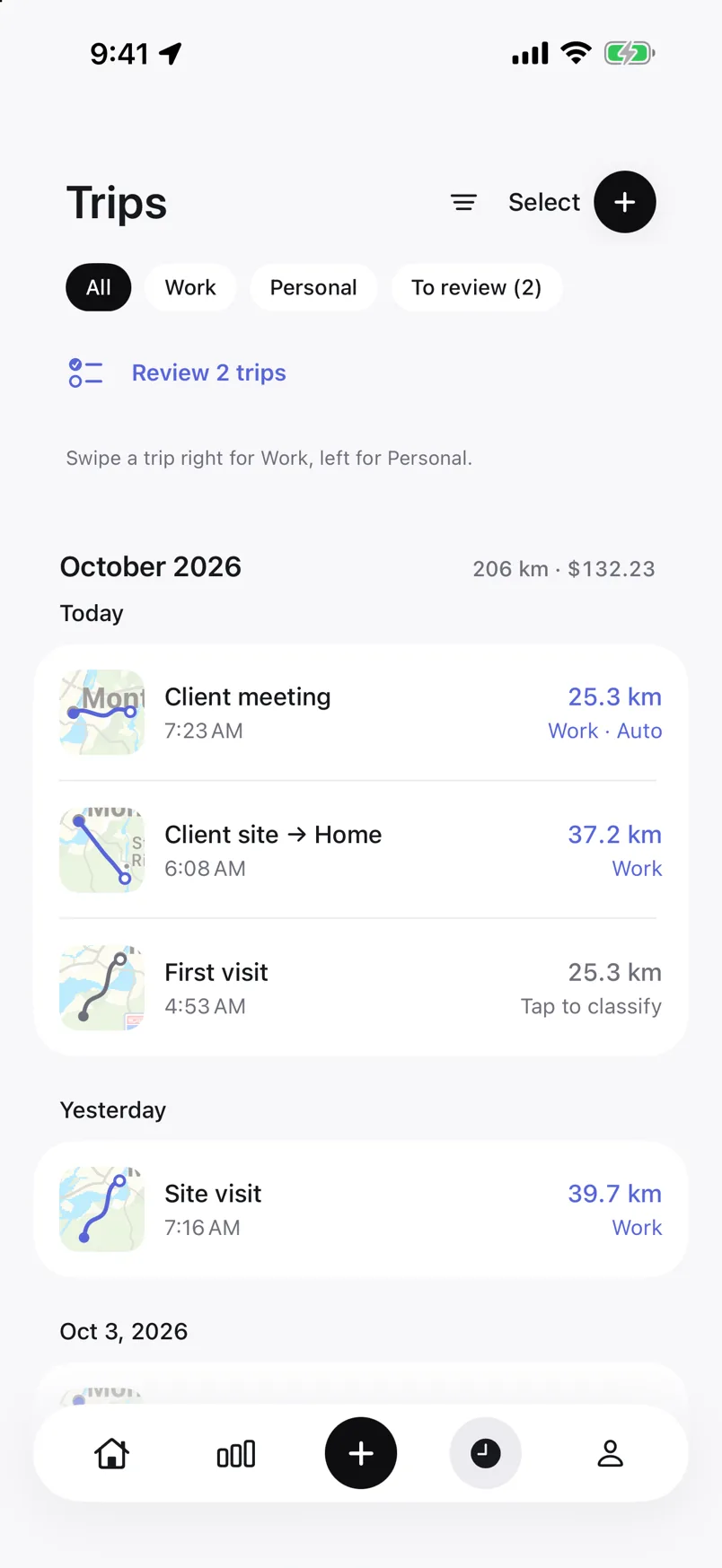 Each drive of the shift recorded on its own, not reconstructed from a platform’s pickup-to-drop-off summary.
A log that runs the whole time a driver is working, not just during a fare, is what closes the gap between what Uber or DoorDash reports and what the miles actually were. Odie starts recording automatically once the car is moving and keeps going until the drive ends, so the miles between one drop-off and the next pickup land in the same log as the miles with a passenger or an order in the car, ready for whichever method the Schedule C ends up using. The mileage log template has the same columns; Odie fills them in as you drive.
The free tier records 40 automatic trips a calendar month. Shifts made of many short drives use that quickly: at 10 drives a shift, 40 is four shifts. Then automatic detection pauses until the 1st (trips logged by hand still work); Odie Pro records without limit, $3.99 USD a month or $29.99 USD a year.
Questions
Can I deduct Uber miles between rides?
The platform’s summary counts only pickup to drop-off, so the miles between jobs, repositioning or waiting for the next ping, have to come from your own log kept while the app is on. In the Columbus example that is 27 miles a shift, or 27 × $0.76 = $20.52 of deduction at the rate since July 1, 2026 (more on the rideshare page).
Do I have to report gig income if I don’t get a 1099-K?
Yes. The IRS says that no matter the amount of reported payments, you must report all income, and a 1099-K from a gig platform only arrives above $20,000 in more than 200 transactions.
How much do I have to earn from Uber or DoorDash to file taxes?
You must file a return if you have net earnings from self-employment of $400 or more from gig work, across all your apps together. Those earnings also carry quarterly estimated tax, due April 15, June 15, September 15 and January 15.
Sources
- IRS: Gig Economy Tax Center
- IRS: Manage taxes for your gig work
- IRS: Understanding your Form 1099-K
- IRS Publication 463, Travel, Gift, and Car Expenses
- IRS: Instructions for Schedule C (Form 1040)
Every figure above is checked against the sources listed. How we check our facts. Not tax advice; your accountant knows your situation. Spotted an error? Tell us.