
Blog · · Updated
IRS standard mileage vs actual expenses
The IRS lets you choose once, in a car's first business year. How the same trips price out both ways, what locks in, and why depreciation can make it close.
A mobile notary in Tempe, Arizona, drives a 2019 Honda CR-V bought for $18,500 in February 2026 to sign loan paperwork at kitchen tables around the valley. Fifteen to twenty signings a week add up: by December the car has logged 12,000 business miles out of 16,000 total for the year. Filing a Schedule C for that car means answering a question the IRS only lets a taxpayer answer once: standard mileage rate, or actual expenses. On the standard rate, with 5,000 of those miles driven before July 1 and 7,000 after, the answer is 5,000 × $0.725 + 7,000 × $0.76 = $8,945 of deduction; on actual expenses it is 75 percent of what the car cost to run and depreciate.
The choice is made once, in the first year
Publication 463 states the timing directly: “If you want to use the standard mileage rate for a car you own, you must choose to use it in the first year the car is available for use in your business. Then, in later years, you can choose to use either the standard mileage rate or actual expenses.” Whichever way the notary goes for this car in 2026, that first-year choice does not get revisited every April. Starting on the standard rate leaves a door open, on the IRS’s terms: “You can’t revoke the choice. However, in later years, you can switch from the standard mileage rate to the actual expenses method. If you change to the actual expenses method in a later year, but before your car is fully depreciated, you have to estimate the remaining useful life of the car and use straight line depreciation for the car’s remaining estimated useful life.” Starting on actual expenses closes the door the other way. Publication 463 lists what locks a car out of the standard rate for good, and two of the entries are choices made in the actual-expenses years themselves: “Claimed a depreciation deduction for the car using any method other than straight line for the car’s estimated useful life,” and “Claimed a section 179 deduction (discussed later) on the car.” Pick actual expenses with accelerated depreciation or a section 179 write-off for that CR-V, and it is on actual expenses for as long as it works for the notary business.
Pricing the year the first way
Topic 510 recommends doing the arithmetic before deciding: “If you qualify to use both methods, you may want to figure your deduction both ways before choosing a method to see which one gives you a larger deduction.” The notary’s 12,000 business miles split across 2026’s two rates, 5,000 of them before July 1 and 7,000 after:
- 5,000 × $0.725 = $3,625
- 7,000 × $0.76 = $5,320
- Total: $8,945
That figure is the whole deduction. Gas, insurance, maintenance and depreciation are already inside the cents-per-mile rate; only parking and tolls get added on top of it.
None of those miles has to be typed in. Odie starts and ends each trip by itself, asks Work or Personal after the drive, and prices each business mile at the IRS rate in force on its date, so the split at July 1 comes out of the trips; dated odometer readings give the 16,000-mile total. Here is how Odie keeps a self-employed mileage log.
Pricing the year the second way
Actual expenses start from receipts, not the odometer. The notary’s real costs for 2026: $2,800 in gas, $1,500 in insurance, $650 in maintenance and repairs, $150 in registration, for $5,100 in operating costs. The business-use share of the car is 12,000 ÷ 16,000, or 75 percent, so the deductible slice of that $5,100 is $3,825.
That is not the full picture, because depreciation is not in it yet. A car placed in service for business has its own depreciation schedule under section 280F, capped by passenger-vehicle dollar limits the IRS updates every year: for a car placed in service in 2025, Publication 463 puts the cap at $20,200 in the first year if the section 168(k) additional first-year depreciation applies, or $12,200 if it does not. What is certain is that only 75 percent of whatever the depreciation comes to, once the MACRS percentage and that year’s cap are applied to the CR-V’s cost, is deductible, stacked on the $3,825, and depending on that number, actual expenses could land above the $8,945 standard-mileage total or well below it. That is a Form 4562 calculation for this specific car, not something Publication 463’s recordkeeping chapter alone answers.
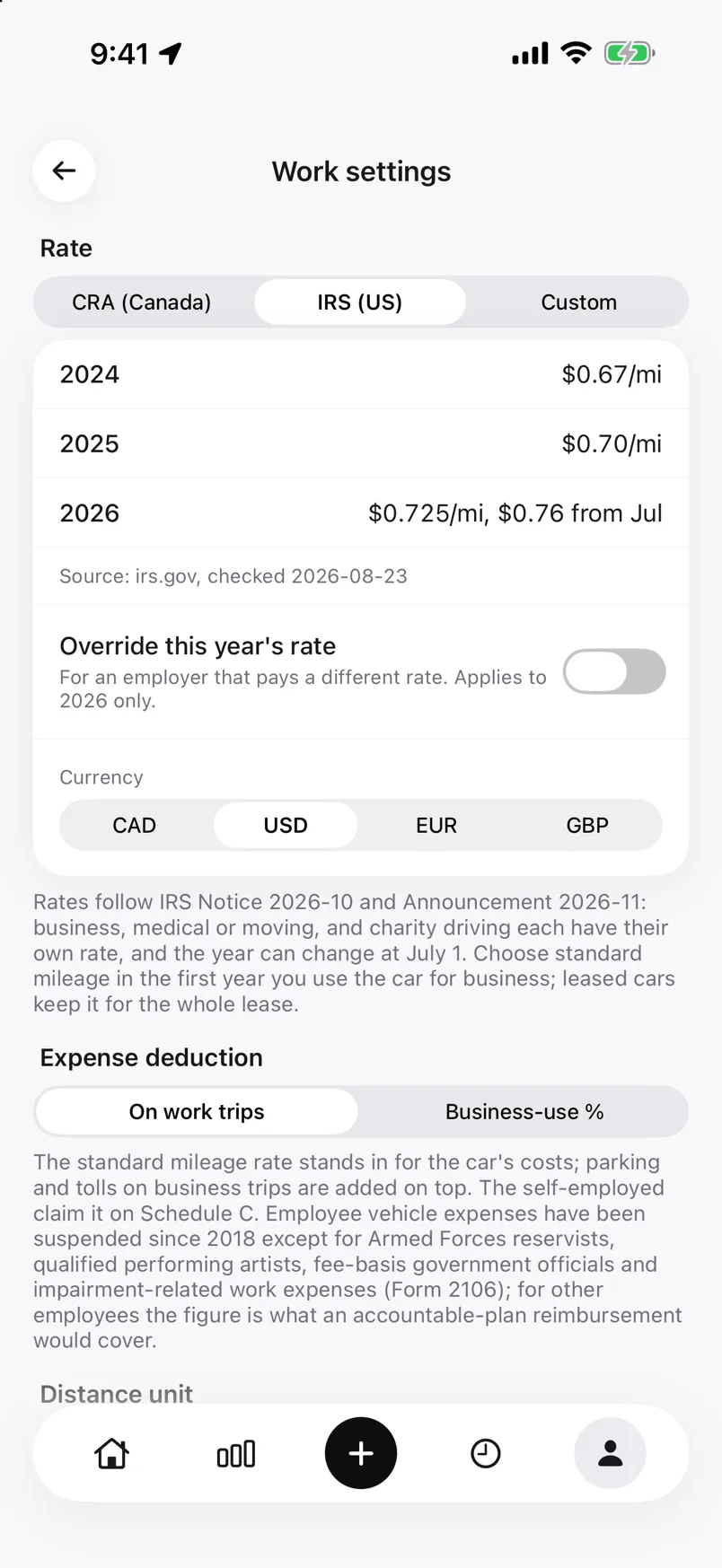 Switching between the standard mileage rate and the business-use percentage method for the IRS scheme.
What locks a car out before the math starts
Two rules apply before the first-year choice is even relevant. “If you own or lease five or more cars that are used for business at the same time, you can’t use the standard mileage rate for the business use of any car,” so a business running a small fleet is on actual expenses for every car in it, whatever the first-year numbers would have said for any single one. A leased car carries its own lock-in: “If you want to use the standard mileage rate for a car you lease, you must use it for the entire lease period,” not just the year it starts.
The records are the same either way
Neither method excuses the log. Publication 463’s Table 5-1 sets out what a car expense has to prove: “the cost of the car and any improvements, the date you started using it for business, the mileage for each business use, and the total miles for the year,” along with the date of each use, “your business destination,” and the business purpose for the expense. Topic 510 is direct about what stands behind a claim: “The law requires that you substantiate your expenses by adequate records or by sufficient evidence to support your own statement.” The 12,000 and 16,000 in the notary’s math above come from that same record, trip by trip, not a year-end estimate.
Odie logs each trip’s date, route and distance automatically and asks Work or Personal after every drive, so the business-mile and total-mile counts behind either method are sitting in the log instead of reconstructed from memory in April. The sample IRS year report (PDF) shows what Odie Pro builds from that log: the monthly table, the trip log and the odometer bounds. Run a distance through the IRS mileage calculator to see what the standard rate alone is worth, and see why 2026 prices trips differently before and after July 1 for the split behind the $8,945 above.
Questions
Can I switch from actual expenses to the standard mileage rate?
Not for a car you own that started on actual expenses. Publication 463 says the standard rate has to be chosen in the first year the car is available for use in your business, and depreciation other than straight line or a section 179 deduction locks the car out of it for good.
Can I switch from the standard mileage rate to actual expenses later?
Yes, in a later year. If the car is not fully depreciated yet, Publication 463 says you estimate its remaining useful life and use straight line depreciation from then on.
Are parking and tolls included in the IRS standard mileage rate?
No. Gas, insurance, maintenance and depreciation are inside the cents-per-mile rate; parking and tolls on business trips are added on top of it.
Can I use the standard mileage rate on a leased car?
Yes, but if you choose it for a leased car you must use it for the entire lease period. If you own or lease five or more cars used for business at the same time, the standard rate is not available for any of them.
Sources
Every figure above is checked against the sources listed. How we check our facts. Not tax advice; your accountant knows your situation. Spotted an error? Tell us.