
Blog ·
Real estate agent mileage deduction (IRS)
Showings, open houses and brokerage drop-offs are business miles for a self-employed agent. Schedule C wants them counted separately, not estimated.
A real estate agent in Plano, Texas starts a Tuesday in September with a 9-mile drive to open a listing for a home inspector, doubles back 14 miles to walk two buyer clients through showings in Frisco, and closes the day with a 6-mile run to the brokerage office to drop off a signed offer. Twenty-nine miles, three stops, no desk in between. Under the rules the IRS applies to a self-employed agent’s Schedule C, only one of those legs needs a second look: the drive to the brokerage. At the IRS standard rate since July 1, 2026 (76 cents a mile), the two client legs are 23 × $0.76 = $17.48 of deduction; the 6-mile brokerage leg adds 6 × $0.76 = $4.56 only if it is not a commute.
The office trip is the one exception
Publication 463 states the rule plainly: “You can’t deduct commuting expenses no matter how far your home is from your regular place of work.” A trip from home straight to a listing, an inspection or a client’s driveway is business mileage, because none of those addresses is the agent’s regular workplace. The brokerage office is different if the agent reports there on a regular basis: that leg falls on the commuting side of the line even on a day that starts and ends with client work. Publication 463 has a separate section for a taxpayer who works mainly from a home office, since a home base changes which trips count as commuting, and that is a question a log should settle with a destination on file, not a guess made at filing time.
What Part IV asks for
Schedule C does not ask for a summary. Part IV, “Information on Your Vehicle,” asks for total miles, business miles, commuting miles and other miles for the year, entered separately, plus whether the vehicle was available for personal use and whether the agent has written evidence to support the deduction. An agent who logs 29 miles on a Tuesday without noting which leg was the brokerage stop has no way to split that day’s total into the four numbers the form wants. Each trip has to carry its own tag, showing, listing, brokerage or personal, recorded when it happens rather than reconstructed from a closing calendar the following spring.
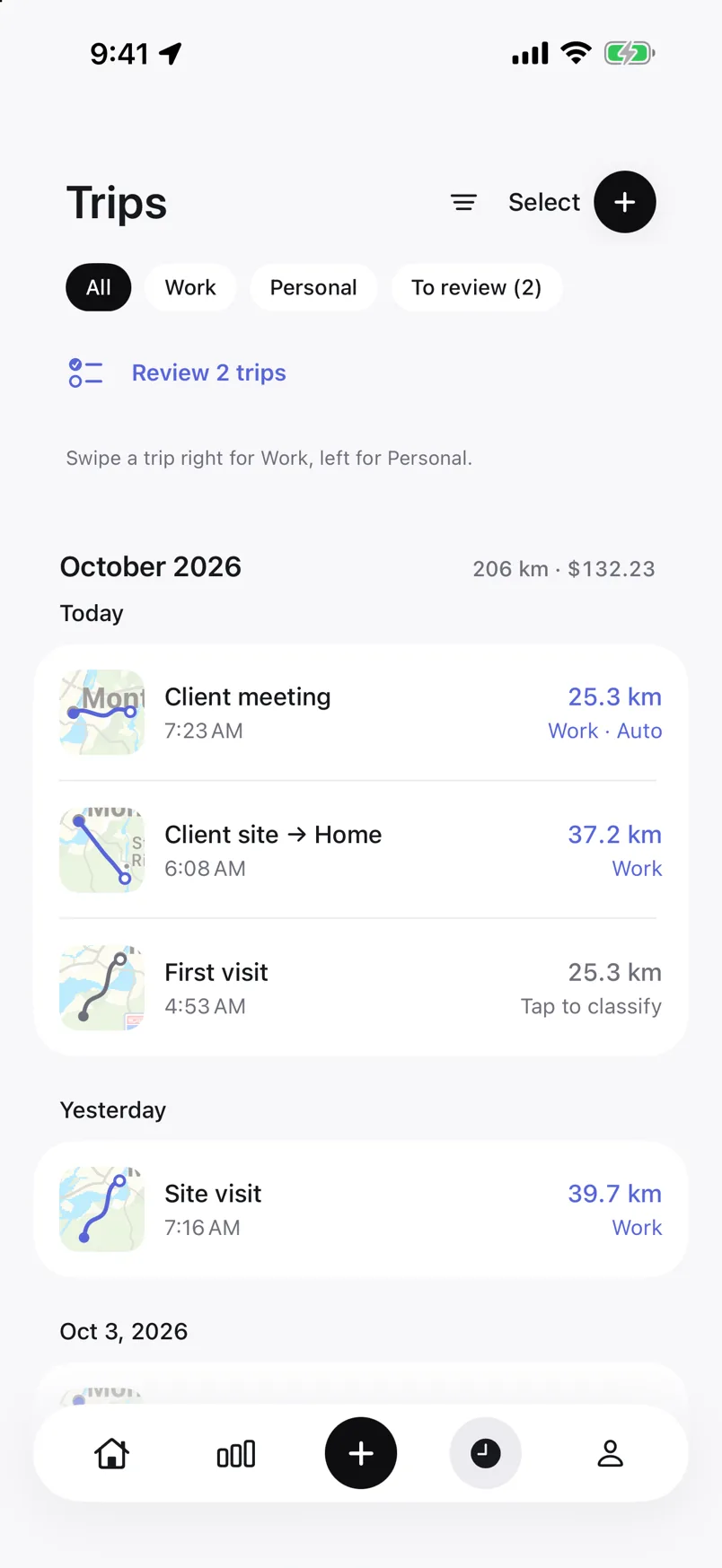 Every trip keeps its own distance and tag, so a day with three stops splits into business and commuting miles without re-tracing the route later.
Odie records each leg as its own trip without anyone typing it: the trip starts when the car starts moving and ends when it stops. The brokerage can be a saved place with its own tag, so the suggestion for that leg is waiting when the trip ends, for the agent to confirm, never applied silently (how Odie works for real estate agents).
The first-year choice, made once per car
Before any of that mileage becomes a deduction, the standard mileage rate itself has to be chosen, and only once: “you must choose to use it in the first year the car is available for use in your business.” An agent who buys a car in March and runs actual expenses that year cannot switch that car to the standard rate later. An agent who starts a car on the standard rate (the two methods are compared in choosing in the first year) keeps the later option of switching to actual expenses if the numbers favor it. A leased car works differently: choosing the standard rate in the first year of the lease locks it in for every year left on that lease, no switching back and forth as gas prices or mileage change.
Five cars is where the standard rate stops
An agent running a two-person team with a second car for open houses, or rotating through a small fleet for showings, hits a hard limit before any of the above matters: Publication 463 says that “if you own or lease five or more cars that are used for business at the same time, you can’t use the standard mileage rate for the business use of any car.” Below that number, the standard rate and actual expenses are a choice made car by car. At five or more, actual expenses is the only method left, for all of them.
What the log has to hold onto
Publication 463’s table of proof for a transportation expense asks, for a car, for “the cost of the car and any improvements, the date you started using it for business, the mileage for each business use, and the total miles for the year,” plus the date of that use, the business destination, and the business purpose. Per trip, that comes down to a date, a destination and a reason, written close to when the drive happened rather than rebuilt from an MLS export after the fact. Odie records each trip’s distance on its own and asks which client or project it belongs to, so a showing in Frisco and the drop-off at the brokerage carry their own tags from the moment they happen, not from memory of which listing came first that Tuesday. The IRS mileage calculator turns a year of business miles into the estimated deduction once a log is split the way Part IV wants it, and the mileage log template has the same columns; Odie fills them in as you drive. The sample year report shows a year of it: miles by month, by client, and every trip with its date, from and to.
Questions
Is driving to my brokerage office deductible mileage?
Not if you report there on a regular basis: Publication 463 says you can’t deduct commuting expenses, and that leg falls on the commuting side. A drive from home straight to a listing, an inspection or a client is business mileage.
What mileage does Schedule C Part IV ask for?
Total miles, business miles, commuting miles and other miles for the year, each entered separately. It also asks whether the vehicle was available for personal use and whether you have written evidence to support the deduction.
How much is a showing mile worth in 2026?
At the IRS standard rate since July 1, 2026, 76 cents a mile, the two client legs in the example above are 23 × $0.76 = $17.48 of deduction. Run a year of business miles through the IRS mileage calculator for the total.
Can a real estate team with five cars use the standard mileage rate?
No. Publication 463 says you can’t use the standard mileage rate if you operate five or more cars at the same time for business purposes, so every car is on actual expenses.
Sources
- IRS: Publication 463, Travel, Gift, and Car Expenses
- IRS: Topic 510, Business use of car
- IRS: Instructions for Schedule C (Form 1040)
Every figure above is checked against the sources listed. How we check our facts. Not tax advice; your accountant knows your situation. Spotted an error? Tell us.