
Blog · · Updated
Can W-2 employees deduct mileage? (IRS)
IRS Topic 510 names three W-2 job categories that still deduct car expenses on Form 2106, and what that means for everyone else driving for work.
A home health aide in Tulsa, Oklahoma drives her own Corolla between four patients a day, about 22 miles of driving strung between the houses. Her agency pays her hourly for the time she spends with a patient and nothing for the miles she spends getting to the next one. Tax season is when she finds out whether that mileage comes off her return the way it would if she billed each visit herself.
Priced at the IRS business rate in force since July 1, 2026, those miles come to 22 × $0.76 = $16.72 a working day. For a W-2 employee that is generally not a deduction. It matters somewhere else: paid back by her employer under an accountable plan, it reaches her tax-free.
Only three kinds of employee still file for it
IRS Topic 510 lays out where a car expense deduction actually lands. Self-employed drivers get the first sentence: “Deduct your self-employed car expenses on Schedule C (Form 1040), Profit or Loss From Business (Sole Proprietorship) or Schedule F (Form 1040), Profit or Loss From Farming if you’re a farmer.” The very next sentence is aimed at a narrower group entirely: “If you’re an Armed Forces reservist, a qualified performing artist, or a fee-basis state or local government official, complete Form 2106, Employee Business Expenses to figure the deductions for your car expenses.” Three categories, named by occupation rather than by income level or industry, each paid or scheduled in a way that puts them closer to a contractor than a salaried employee: a reservist called up for drill duty away from a civilian job, a performing artist moving between short engagements for different employers in the same year, an official paid per assignment instead of a fixed salary.
The home health aide is none of those, and neither is she self-employed. Her W-2 lists one employer and one salary, and Topic 510 gives that arrangement no line of its own, not on Schedule C and not on Form 2106.
The page has no third door
Between the self-employed route and the three named exceptions, Topic 510 does not mention a form for anyone else. It does not explain why the line stops where it does, and this article will not guess at a reason the page itself does not give. What it says plainly, by leaving the gap open, is that a home health aide, a warehouse worker who runs errands in a personal car, or a delivery dispatcher on payroll has no Schedule C and no Form 2106 to reach for.
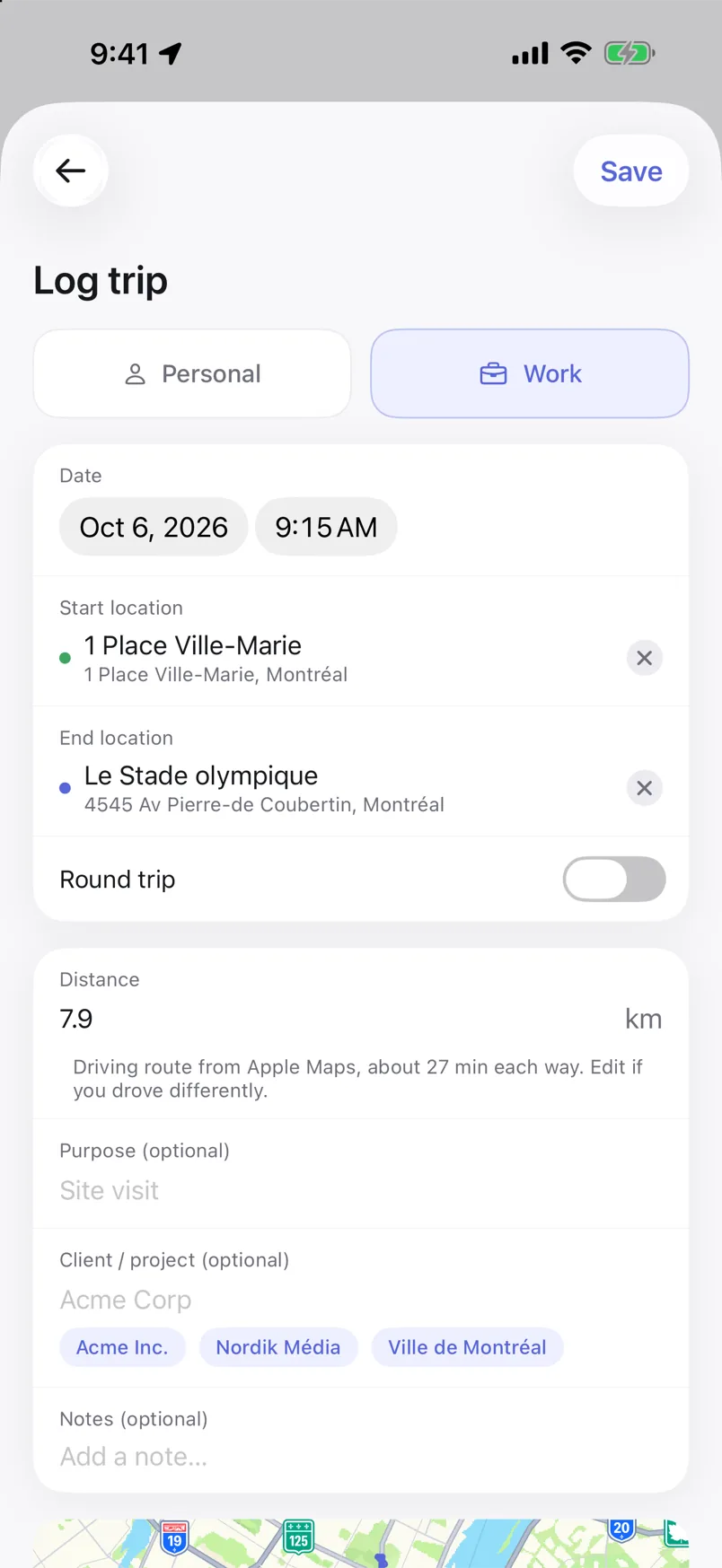 A logged trip: date, destination and distance are what any of these forms eventually ask for, deduction or reimbursement.
The question that replaces the deduction
Once the deduction route is closed, the useful question changes shape. Instead of asking how large a deduction those 22 miles a day would produce, the aide’s real opening is with her employer directly: whether the agency will pay the mileage back through payroll. An employer reimbursement plan is a separate set of rules from Topic 510 and outside what this page covers, but it is the door that stays open once the tax-return door does not. A conversation about a per-mile rate added to her pay has nothing to do with Schedule C, and nothing stops an employer from offering one regardless of what Topic 510 says about employee deductions.
That conversation goes better with a number in it. An agency asked to start reimbursing mileage will want to know how many miles a week it is actually agreeing to cover, and a driver who shows up with three months of dated trips has a stronger case than one who estimates from memory. The same math the IRS would have used on a Form 2106, miles multiplied by a rate, works just as well as a proposal to a manager who has never had to think about it.
Odie keeps those dated trips without typing. It starts and ends each drive by itself in the background, recognising the Corolla by its hands-free Bluetooth name, and asks Work or Personal with one tap from the lock screen. It needs no account: the trips stay on her iPhone, with optional sync through her own iCloud.
Records outlast the question of who pays
Whichever door applies, the underlying facts are the same four things: the date, the destination, the miles, and the reason for the drive. An employer weighing a reimbursement request wants that list as much as a Form 2106 preparer would. Odie records the date, route and distance of each drive automatically and asks Work or Personal afterward, so an aide, a reservist, or anyone else in this position has the list ready whether it goes to a manager, an accountant, or nowhere at all that year. The sample year report shows what that list looks like at the end of a year: miles by month, then every trip with its date, from, to and miles (the report is part of Odie Pro).
A W-2 today is not permanent. Someone who becomes fee-basis, picks up 1099 work on the side, or qualifies under one of the three named categories later will want a mileage calculator and the current IRS rate on hand the day that changes, and a log that already covers the driving in question rather than one that starts from zero.
Questions
Which employees can still file Form 2106 for car expenses?
IRS Topic 510 names three: Armed Forces reservists, qualified performing artists and fee-basis state or local government officials. Other W-2 employees have no Schedule C and no Form 2106 line for their work driving.
Is mileage reimbursement from my employer taxable?
Paid back under an accountable plan, it reaches the employee tax-free. At the IRS rate of 76 cents a mile from July 1, 2026, 22 miles a working day is $16.72.
Can I deduct mileage for 1099 work I do on the side?
Self-employed car expenses go on Schedule C, so driving for work you bill yourself is claimed there, at the IRS standard rate if you use it. Driving for your W-2 job stays outside that claim.
Sources
Every figure above is checked against the sources listed. How we check our facts. Not tax advice; your accountant knows your situation. Spotted an error? Tell us.