
Blog · · Updated
Accountable plan rules for mileage reimbursement
How employers keep mileage reimbursements tax-free and off your W-2: the IRS’s three accountable plan rules, the 30, 60 and 120-day deadlines, and missed ones.
A field technician for an HVAC company in Reno, Nevada drives 1,140 miles in February 2026 across Washoe County on service calls, then files an expense report at the company’s 72.5-cent allowance: 1,140 miles × 72.5¢ = $826.50. Two weeks later the amount shows up in her direct deposit, separate from her paycheck, and nothing about it appears on her W-2 at year end. That last part is not automatic. It happens because her employer’s reimbursement arrangement meets three conditions the IRS calls an accountable plan, and if any one of them had slipped, the same $826.50 would have landed in box 1 as wages.
The three conditions
Publication 463 lists them as rules, not suggestions: “Your expenses must have a business connection”, “You must adequately account to your employer for these expenses within a reasonable period of time”, and “You must return any excess reimbursement or allowance within a reasonable period of time.” The technician’s driving clears the first rule because it happened while she was doing her job, not commuting to it. The other two are about paperwork and timing, and Publication 463 is specific about both.
Adequate accounting means handing the employer “a statement of expense, an account book, a diary, or a similar record” entered at or near the time of each trip. A car allowance can stand in for that record, but only if it is “similar in form to and not more than the federal rate”, meaning the IRS standard mileage rate or a comparable fixed-and-variable-rate plan. The technician’s employer pays exactly the IRS rate, so the allowance itself satisfies the accounting requirement, provided she still proves the date, mileage and business purpose of each trip.
The clock the IRS sets
“The definition of reasonable period of time depends on the facts and circumstances of your situation,” Publication 463 says, but then gives four situations that count as reasonable no matter what: an advance received within 30 days of the expense, accounting for the expense within 60 days after it was paid or incurred, returning any excess reimbursement within 120 days, and, for a running account, complying within 120 days of a quarterly statement.
The technician’s report, filed within two weeks of her last service call, clears the 60-day window with room to spare. The 120-day rule matters more for an advance. Publication 463 works through this with a travel example: an employee given a 5-day, $450 advance who only travels 3 days has to return the unused $180 within a reasonable period, while a small gap between the advance and the federal rate for those 3 days does not have to be returned at all, though it gets added to wages either way. The same logic would apply if the Reno company had advanced the technician money before the month started: drive fewer miles than the advance assumed, and the difference goes back; drive them all, and there is nothing to return.
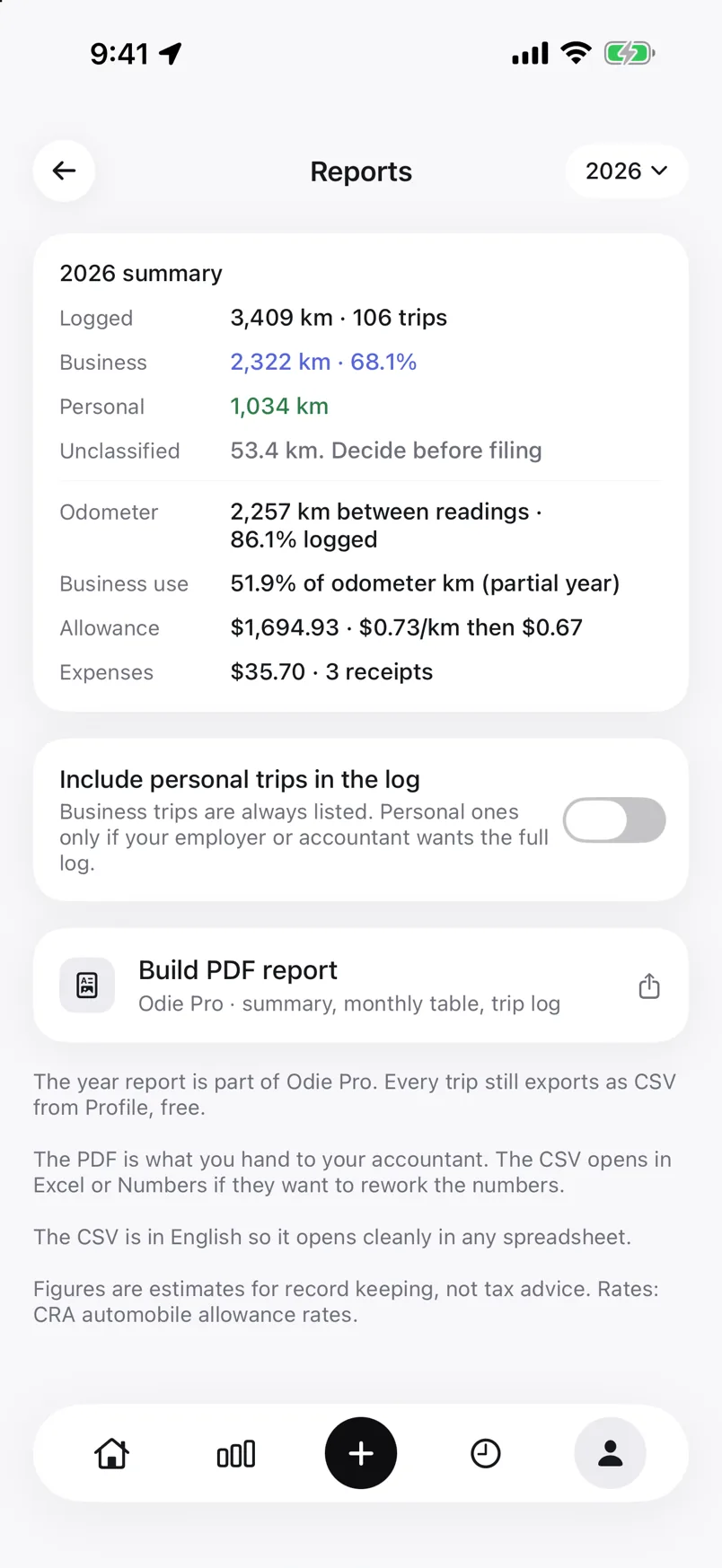 A report totaling the miles and the rate used, the record an accountable plan asks an employee to keep.
What changes at the mid-year rate split
The IRS mileage rate for 2026 is not one number for the year: 72.5 cents through June 30, 76 cents from July 1 on. An employer using the standard mileage rate as its car allowance has to apply the rate that was in effect on the date of each trip, not a single average for the year. A technician who drove the same 1,140 miles in August would file for $866.40, not $826.50, and a company that pays the old rate after July 1 is reimbursing below the federal rate, which does not break the accountable plan but does leave a gap the employee can claim nowhere, since most employees lost the unreimbursed employee expense deduction after 2017.
Odie handles the split by date. It starts and ends each trip by itself, records the date, route and distance, and prices each work trip at the rate in force on its date, so February miles sit at 72.5 cents and August miles at 76 cents; if the employer pays another figure, an override for the year replaces it. Trips are stored on the phone and in your own private iCloud database, and none of it is sent to us.
When the paperwork slips
Miss any of the three conditions and Publication 463 is direct about the result: “the amounts paid in excess of the substantiated expenses are treated as paid under a nonaccountable plan.” A nonaccountable reimbursement goes into box 1 with the rest of the technician’s wages, subject to income tax and payroll tax withholding like any other pay. Getting it back off her return afterward is not simple. Form 2106, the form that would let her deduct unreimbursed vehicle expenses, is now restricted to a short list Publication 463 names directly: “Armed Forces reservists, qualified performing artists, fee-basis state or local government officials, and employees with impairment-related work expenses.” An HVAC technician is none of those, so a reimbursement that fails the accountable-plan test simply becomes taxable income with no offsetting deduction on the other side.
The paperwork that keeps a reimbursement out of that situation is the same paperwork a mileage log already produces: a date, a business purpose and a distance for every trip, filed before the next quarterly statement comes due. The mileage log template has the same columns; Odie fills them in as you drive. It logs each trip automatically with that date, distance and route, tags it Work or Personal, and builds a report totaling the miles at whatever rate the employer uses, the record an accountable plan is built to check. The sample year report shows what an employer would receive.
Questions
Is mileage reimbursement taxable income in the US?
Not when the employer’s arrangement is an accountable plan: the reimbursement stays off the W-2. If any of the three conditions fails (a business connection, adequate accounting, return of any excess), the amount is treated as paid under a nonaccountable plan and goes into box 1 as wages.
How long do I have to turn in a mileage report under an accountable plan?
Publication 463 treats accounting for an expense within 60 days after it was paid or incurred as reasonable. Returning excess reimbursement within 120 days, and receiving an advance within 30 days of the expense, also count as reasonable.
What mileage rate should my employer use after July 1, 2026?
An employer paying the IRS standard rate applies the rate in force on each trip’s date: 72.5 cents a mile through June 30 and 76 cents from July 1. The same 1,140 miles comes to $826.50 in February and $866.40 in August.
Can I deduct mileage my employer didn’t reimburse?
Generally not as a W-2 employee. Form 2106 is limited to Armed Forces reservists, qualified performing artists, fee-basis state or local government officials, and employees with impairment-related work expenses; more in can W-2 employees deduct mileage.
Sources
- IRS Publication 463, Travel, Gift, and Car Expenses
- IRS Tax Topic 510, Business Use of Car
- IRS Notice 2026-10, 2026 Standard Mileage Rates
Every figure above is checked against the sources listed. How we check our facts. Not tax advice; your accountant knows your situation. Spotted an error? Tell us.