
Mileage log · Outdoor and home services
Mileage tracker for landscapers and snow removal
A route of lawns from May to October, then driveways and parking lots when the snow comes. Landscaping is a dozen short business drives a day, plus nursery and dump runs. Odie logs each stop from your truck.

No account. Free for 40 automatic trips a month, no card.
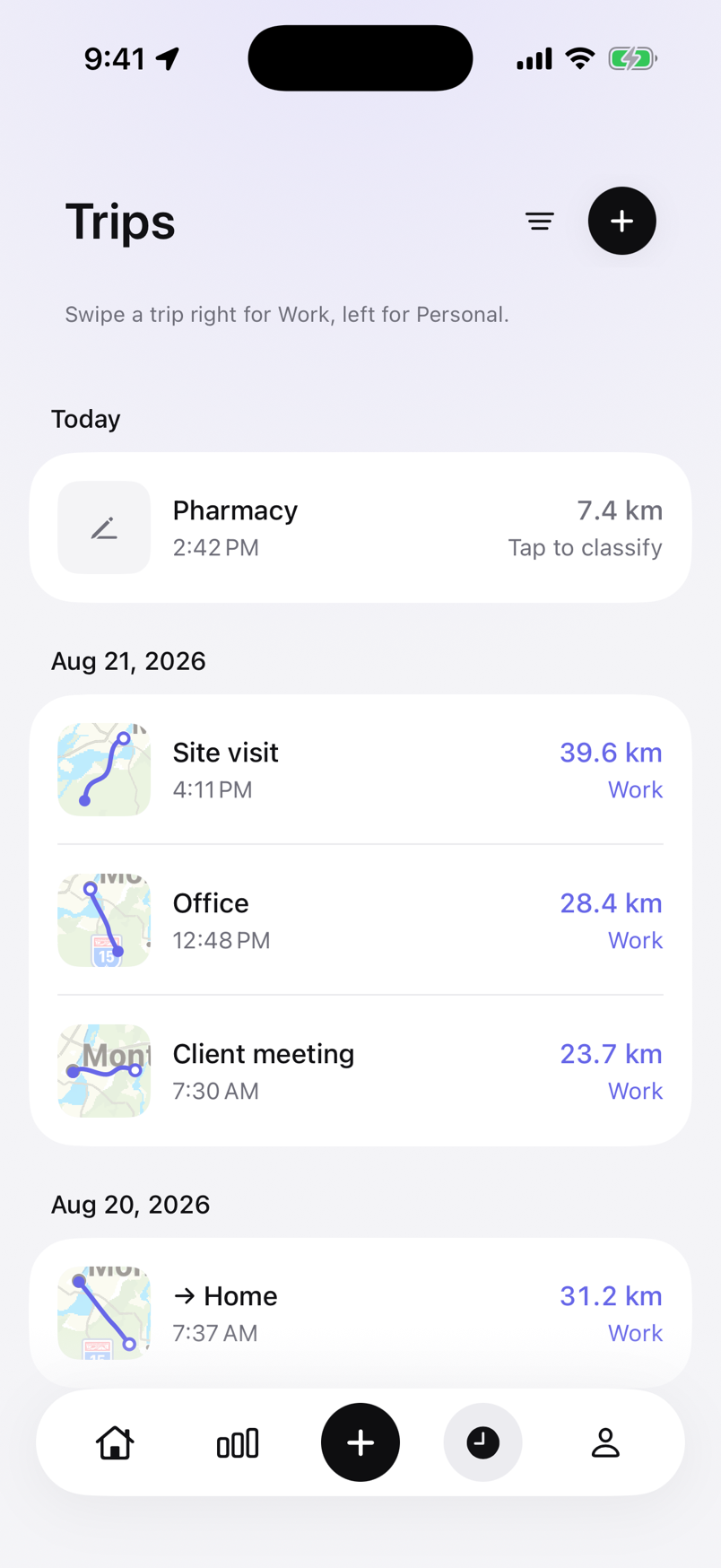
A day on the road
A Tuesday on the summer route:
- WorkHome yard to the first lawn on the route
- WorkLawn to lawn, eight stops on the same side of town
- WorkRoute to the garden centre for mulch
- WorkGarden centre to a planting job
- WorkPlanting job to the green waste depot, then home
The odometer readings at the start and end of the year matter more than usual here: the truck may sit for weeks between seasons.
What counts as business driving
In the log as Work
- Every stop on the route
- Nursery, garden centre and supply runs
- Green waste and dump runs
- Estimates for new clients
- Snow removal routes in winter
Not business
- Personal driving in the truck
- Home to a yard you report to as an employee
- Personal stops on the route
What the log is worth
A worked example for a self-employed driver in each country. Your numbers will differ; the method is the same.
Canada · self-employed
16,000 business km out of 24,000 km in total is 66.7% business use. Applied to $11,000 of car costs for the year, that is
$7,333
Deducted on the T2125. There is no per-kilometre deduction for the self-employed: it is a share of real costs, and the log proves the share.
The CRA on motor vehicle expensesUnited States · self-employed
10,000 business miles at the IRS standard rate of 76¢ (Jul 1 to Dec 31, 2026) is
$7,600
Deducted on Schedule C if you use the standard mileage rate. Business parking and tolls go on top.
Schedule C instructionsYour vehicle
Most landscapers run a pickup with a trailer, which may also be the household’s second vehicle in the off-season. Running costs are deducted as the business share, and the truck goes through capital cost allowance.
Expenses to keep with the log
- Fuel, often the largest line
- Insurance, licence and registration, as the business share
- Repairs, tires and maintenance
- Loan interest or lease
What Odie does
- Starts a trip when your vehicle’s Bluetooth connects and you are moving, and ends it when you park.
- Asks Work or Personal from the lock screen, and suggests the answer after the same route twice.
- Keeps fuel, charging, parking and toll receipts next to the trips.
- Builds the year report: summary, monthly and per-client totals, expenses, the trip log and the odometer readings.
Saved places for regular clients carry a Work tag, so route stops are suggested as Work as soon as you park. See a sample year report (PDF)
Questions
I only work in summer. Does the log cover the whole year?
The business trips are only in season, but the business share is calculated on the whole year’s kilometres. That is why the CRA asks for odometer readings at the start and end of the year.
I use the truck for snow removal too. Is that the same log?
Yes, the same vehicle and the same log. Both seasons’ business kilometres add up to the year’s business share.
I run a crew with two trucks. What changes?
Each vehicle has its own records and odometer readings. Odie Pro tracks more than one vehicle and recognises each by its Bluetooth name.
Informational, not tax advice. Your accountant knows your situation.
Guides
-
CRA mileage allowance vs self-employed deduction
A T2200 employee and a T2125 sole proprietor account for the same driving in different ways. The two systems side by side, with one worked example.
-
Capital cost allowance for a vehicle in Canada
How a vehicle's purchase price turns into a yearly deduction on Form T2125, the $39,000 line that sets the class, and what changes for an electric one.
-
Odometer readings for a CRA mileage log
Why the CRA asks for odometer readings at the start and end of the year, how two readings turn a log into a T2125 percentage, and a monthly check for gaps.
Your next work trip can log itself.
Odie is on the App Store, free to start.